

Share your love
Desert Fox Fuel Cells: How to Carry Spare Fuel on an Adventure Bike
Desert Fox fuel cells carry 3, 6 or 20 litres of spare fuel and roll up when empty. How they mount, how far they take you, and what they cost.
Anyone who has ridden the Karoo, the Kalahari or the long roads into Namibia knows the feeling: the fuel light comes on, and the next town is still a long way off. Carrying extra fuel on an adventure motorcycle can be the difference between reaching the next pump and waiting at the side of the road. The challenge on a bike has always been space. Not every bike can take a jerry can, and fitting an expensive long-range tank is not always an option.
That is the gap Desert Fox fuel cells fill. Sold by Flying Brick Motorcycle Accessories in Cape Town, these flexible fuel bladders carry 3, 6 or 20 litres, strap on almost anywhere, and roll up small when they are empty.
Why a fuel bladder instead of a jerry can
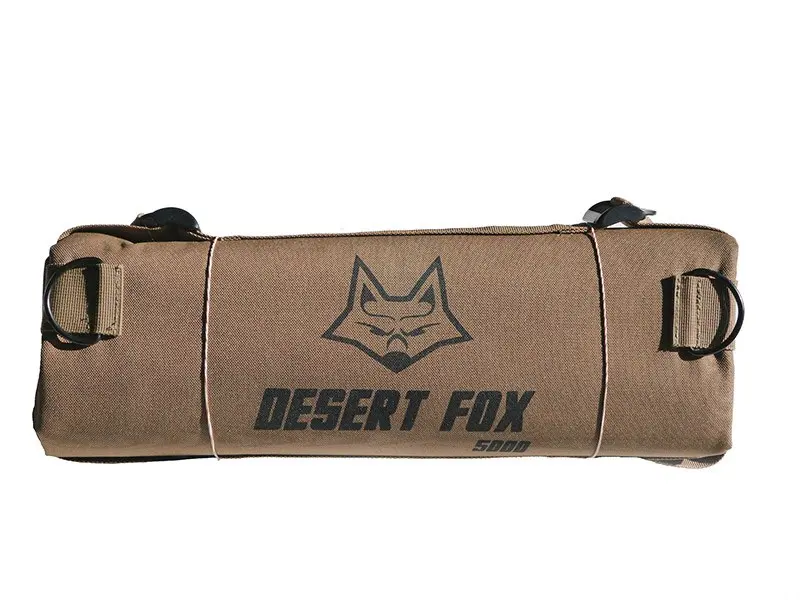
Desert Fox fuel cells were designed for the military, and they are built to carry fuel in rough conditions. They are strong and light: the 3 and 6 litre cells weigh about 0.4 kg empty, and the 20 litre cell 0.9 kg. When a cell is empty you simply fold or roll it, so it can be stored in a confined space, leaving you with more room when you need it most. It fills from any petrol pump, and each cell has its own pouring spout, which stays in a dust-proof pouch on the outside of the cell.
Compared with a hard long-range tank or a jerry can, a fuel bladder costs less and weighs less, and it only takes up real space when it is full.
How far will a few extra litres take you?
It is worth doing the sums before a long trip. A bike that uses 5 litres per 100 km covers about 60 km on 3 extra litres and about 120 km on 6. A thirstier big twin using 6.5 litres per 100 km gets about 45 km and 90 km. On a route where the fuel stops are a full tank apart, that margin can carry you past a pump that is closed or empty, or round a detour you did not plan for.
Work it out with your bike’s real consumption, loaded with luggage and at your normal cruising speed, because that is usually thirstier than the figure in the brochure.
Mounting a fuel cell on your bike
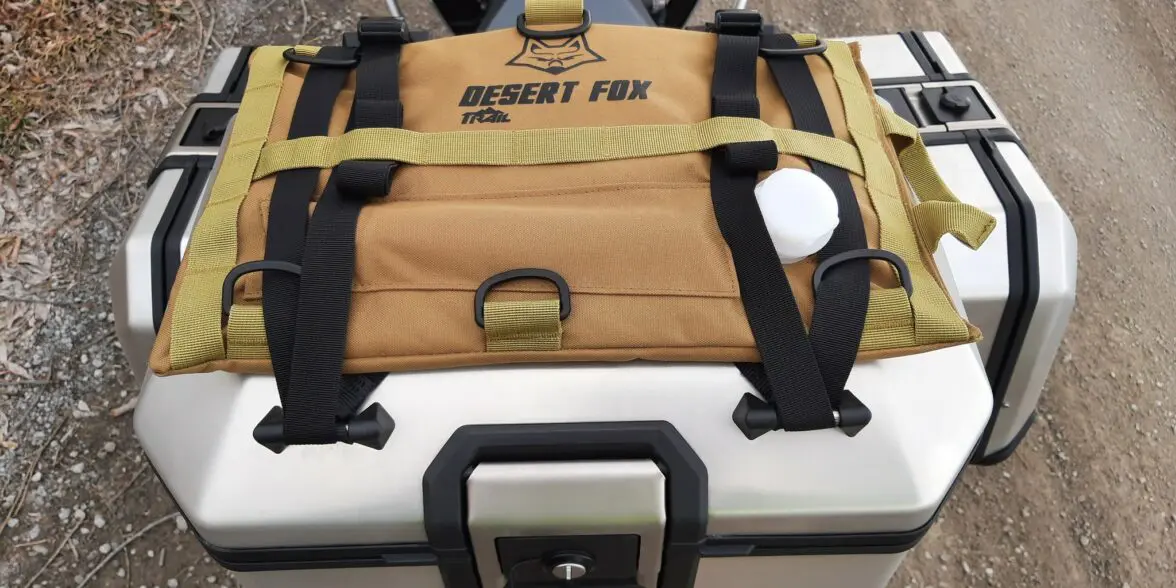
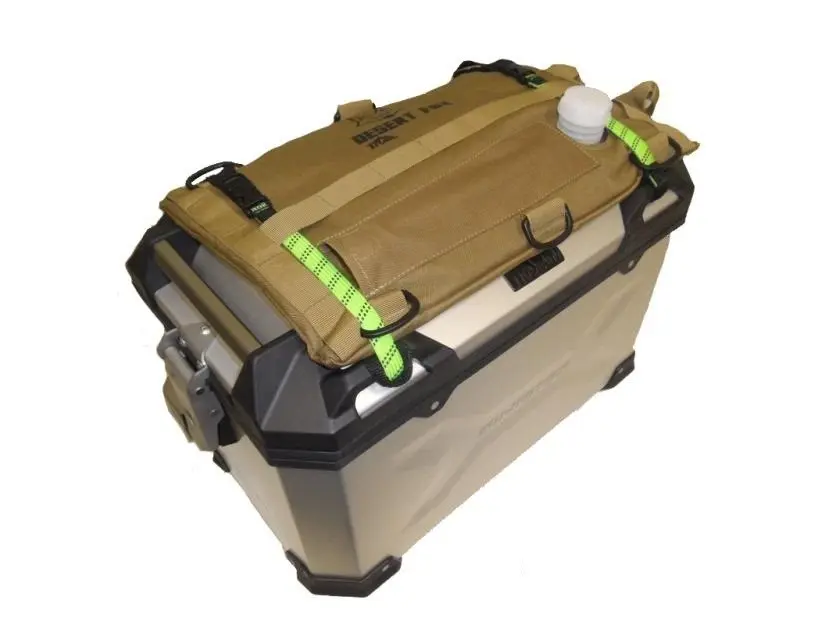
Each cell has mounting points built in: steel D-rings, daisy chains and, on some models, integrated straps, so it can be tied down in almost any position. Rok Straps, bungee cords or other tie-downs all work.
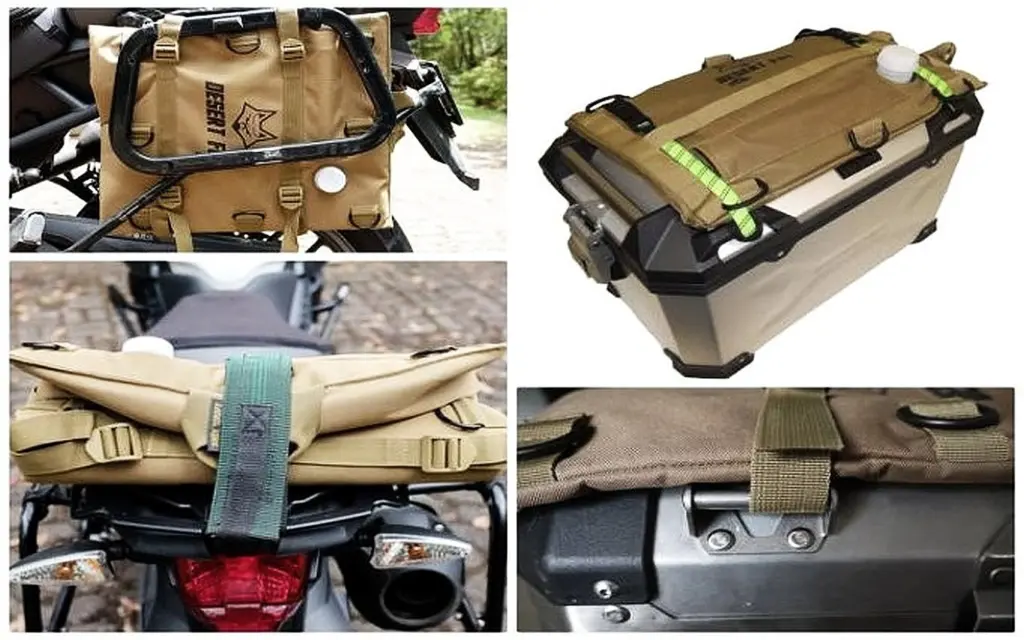
The most common places are on top of the panniers or a top box, on a rear rack, or on top of a roll bag. Smaller cells give you more options. Two 3 litre cells mounted in different places, instead of one larger cell, means that if one is damaged you still have fuel in the other.
Wherever it goes, keep the cell away from the exhaust and hot engine parts, make sure nothing sharp can rub through it, and check the straps at every stop.
Three sizes
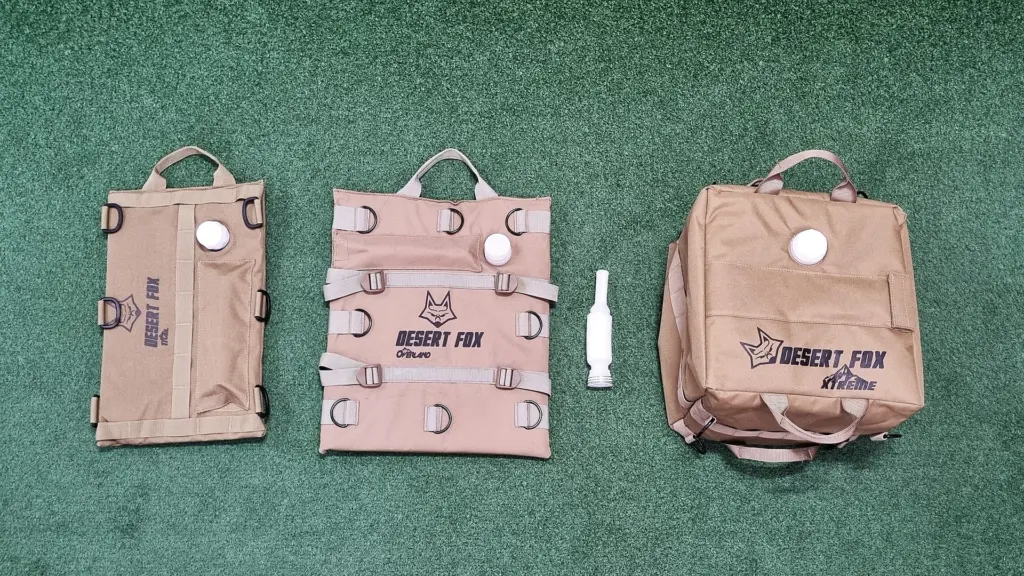
Desert Fox Trail 3 litre
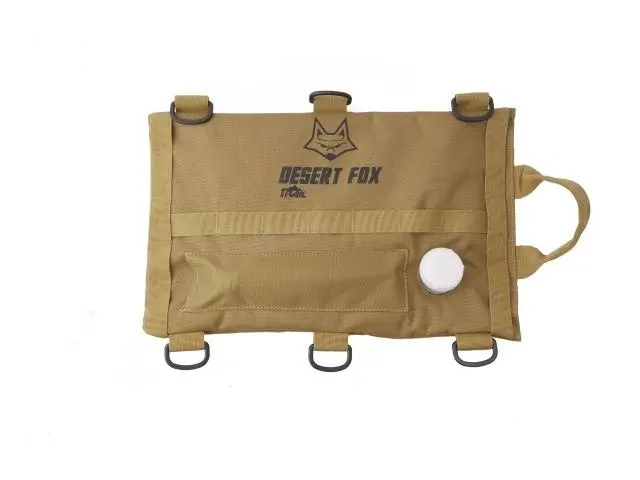
The Trail 3 litre is designed for enduro riders and adventure tourers, and it is the ideal way to carry a little extra in reserve. It measures 40 cm by 24 cm and weighs 0.4 kg empty, with eight D-rings and daisy chains all the way round, so it sits neatly on top of panniers or a top box, or wherever space is at a premium. Empty, it packs small enough to fit into most hydration packs. It costs R690.
Desert Fox Overland 6 litre
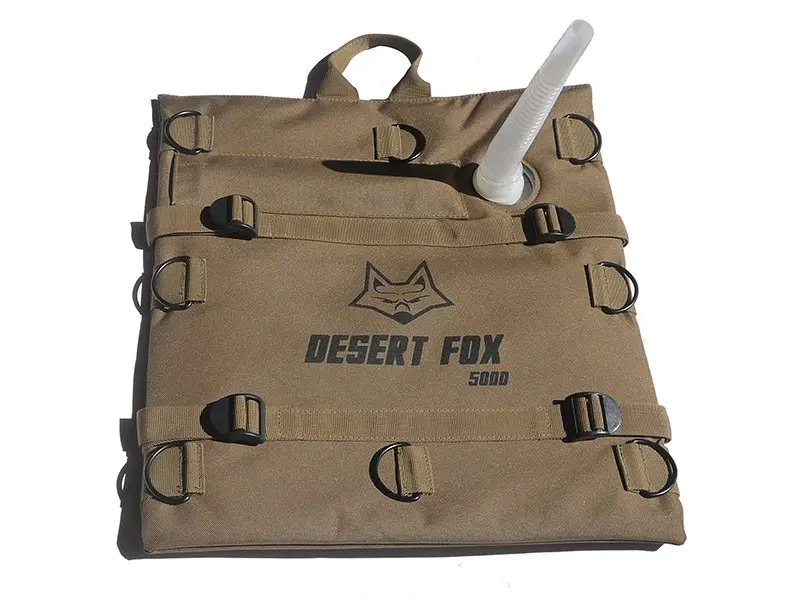
The Overland 6 litre suits most long-distance riding. It measures 40 cm by 35 cm and weighs 0.4 kg empty, and it has six strong steel D-rings, which suit Rok Straps, plus integrated cinch straps that hold it on top of a roll bag, on the panniers or on a rear luggage rack. It costs R790.
Desert Fox Xtreme 20 litre
The Xtreme 20 litre is a collapsible jerry can for 4x4s and motorcycle back-up vehicles. It is ideal for carrying emergency fuel in the boot of a car or a back-up vehicle, and it can be strapped to a roof rack with its steel D-rings and daisy chains. The sides are padded, the base has a shape maintainer that stops it sagging, and four handles make it easy to pour. It holds petrol or diesel, is a 30 cm cube when full, weighs 0.9 kg empty and comes with a 250 mm spout. The beauty of the 20 litre is that it collapses to half its size when you do not need the fuel. It costs R895.
Filling, using and storing a fuel cell
Fill the cell at the pump like any other fuel container, close it properly, and strap it down before you ride. When you need it, fit the spout and pour the fuel straight into your tank, then roll the empty cell up and pack it away until the next long stretch.
Once a cell has carried fuel, keep it for fuel. Desert Fox cells can carry water, but only if they have never been used for fuel.
Spare fuel is one half of being self-sufficient on a long ride. The other is being able to fix a puncture, and Flying Brick’s guide to the BeadMaster Bead Breakers covers that.
Price and where to buy
At the time of writing, the Trail 3 litre costs R690, the Overland 6 litre R790 and the Xtreme 20 litre R895. All three are available from the Flying Brick store in Paarden Eiland, Cape Town, and online in their fuel and water carrying range, with delivery nationally and worldwide. Check stock before you travel to collect.
Visit the Flying Brick store at 8 Shropshire Street, Paarden Eiland, Cape Town, call the shop on 021 510 6455, or call or WhatsApp 067 278 1893.
Prices from Flying Brick’s online store, November 2026. Prices may change.