
Share your love
Suzuki’s GSX-10R Is a Superbike for the Rest of Us
Suzuki's new GSX-10R: a 999cc four with 150 hp, Suzuki's first slide control, cornering ABS, cruise control and an 810 mm seat. Specs, colours and local news.
Be honest about the last time you used all of your litre superbike. Not the last time you opened the throttle on a quiet stretch past Middelburg, but the last time you used the bike the way its engineers imagined, with a circuit in front of you and a lap time to chase. For most owners the answer is a long time ago, if ever. The bike has been on the N1 at 120 km/h, in Saturday morning traffic, and outside a coffee shop, where its 200 hp-plus engine, its aggressive tank-over-the-bars riding position and its price tag have all been mostly wasted.
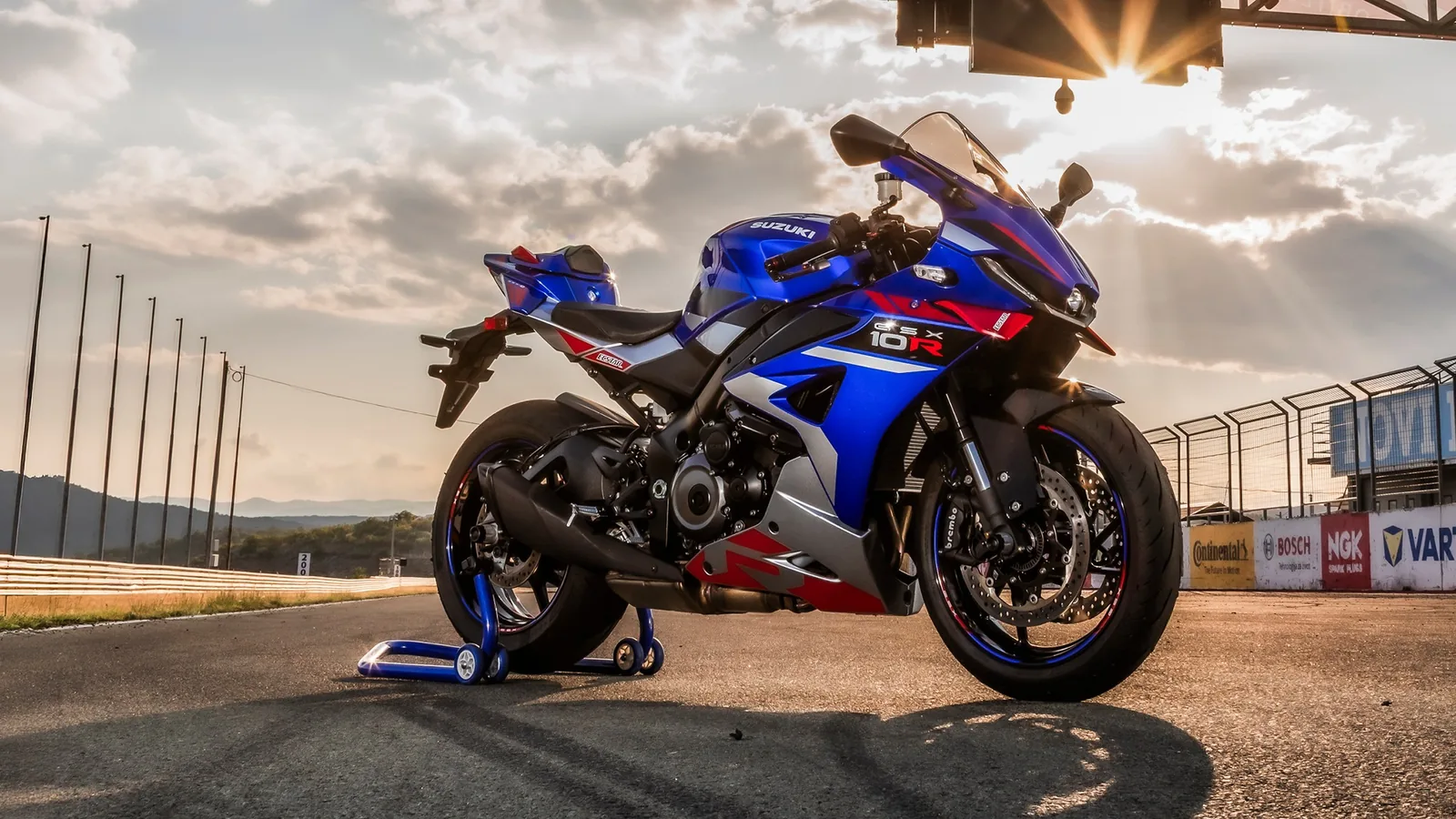
Suzuki seems to have noticed. At EICMA in Milan on 3 November it revealed the GSX-10R, a 999cc sports bike that it says is meant to be enjoyed “everywhere from the racetrack to the city”, as Suzuki UK puts it. It does not replace the GSX-R1000R, which Suzuki says pursues absolute performance. The 10R sits beside it as the bike for the rest of us. Our view, and it is only a view until we have ridden one: this is the most sensible thing Suzuki could have done with its famous engine.
Where 150 hp actually gets used
Start with the number that will make forum warriors sniff. Suzuki quotes 152 PS, which is 150 hp (112 kW), at 11,000 rpm. That is a long way below the 200 hp-plus that top superbikes now advertise, and on a spec sheet it looks like a demotion. On the road it is anything but.
Think about where you actually ride. A Karoo straight with a headwind. A long drag up a mountain pass behind a truck. An overtake on the N3 where you need to be past three bakkies before the oncoming car arrives. None of those situations calls for a peak figure at 13,000 rpm that you will never visit. They call for a strong, flexible engine that pulls hard from where you actually are, and Suzuki’s number that matters here is 106 Nm at 9,250 rpm, and Suzuki points to the broad spread of power this engine is known for. On the Highveld, where thin air takes something from every engine, we would rather have a bike that is not already living at the edge of its rev range.
The three power modes are worth a mention for the same reason. Suzuki says each has the same peak power but a progressively softer throttle map, so the soft setting does not turn the bike into a lawnmower. It simply makes the first part of the throttle gentler for wet roads, gravel-strewn corners or a pillion who does not enjoy surprises. Think of it as a volume control, not a limiter.
An engine everyone already trusts
The engine is not new, and that is a strength. Visordown traces it to the K5 GSX-R1000, from 2005, which many riders still call one of the great superbike engines, via the GSX-S1000 that has been on sale for years. It has the long record that a bike you plan to keep for a decade should have.
That does not mean Suzuki simply bolted it in. The 10R gets new camshafts, a new cam chain sprocket, a new cylinder head, barrels, cases and crank journals. Suzuki says the aim is to balance performance and reliability, and to prepare the engine for future alcohol-blended fuels. Visordown adds that the exhaust valve specification and the cam chain were changed for reliability and lower noise, and that the bike is Euro 5+ compliant. A four-into-one exhaust carries the sound, and a slip-and-assist clutch keeps the lever light, which you will appreciate in stop-start traffic on a hot afternoon, and smooths downshifts when you arrive at a corner a little too quickly.
A sports bike you could sit on for three hours
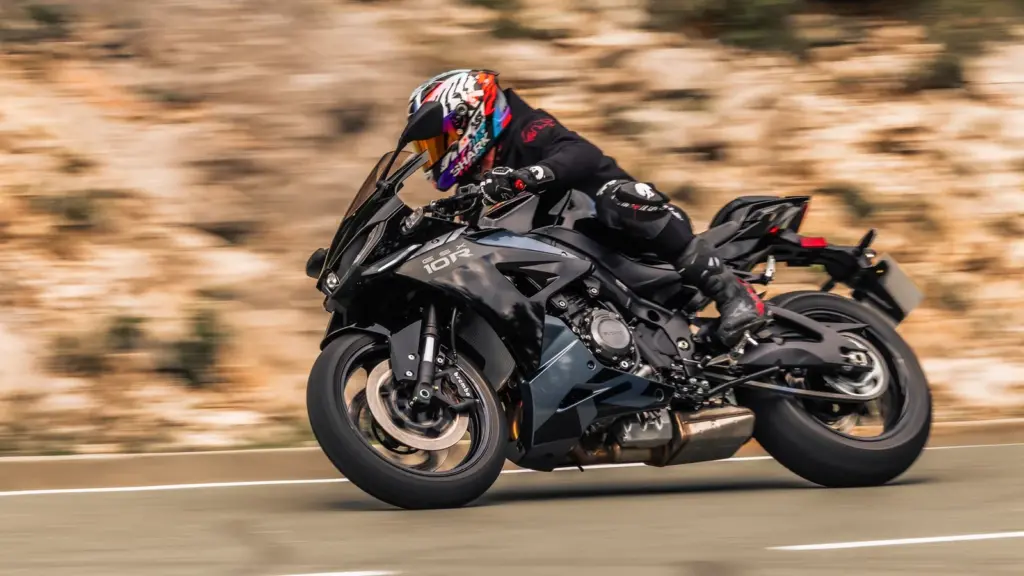
Here is where the 10R either earns its keep or does not. Suzuki has kept the serious bits of the GSX-R1000R’s geometry. The aluminium frame’s main spars run in a straight line from the steering head to the swingarm pivot, and the steering offset drops from 35 mm to 30 mm, closer to the GSX-R1000R’s 28 mm, so the front end should feel sharp when you tip it in. A new aluminium swingarm and subframe complete the structure. The seat, handlebar and footpeg positions mirror the GSX-R1000R’s, so this is a proper sports riding position, not a sit-up tourer in a fairing.
What Suzuki has done is soften the edges around it. The seat is 810 mm, 15 mm lower than the GSX-R’s, which will help shorter riders flat-foot at a robot on a steep Joburg street. Visordown reports softer seat padding and a new seat shape that lets you move around when riding hard. The tank holds 18 litres, which is welcome when the next filling station in the Karoo is a long way off. Visordown reports a claimed kerb weight of 214 kg, a 1,455 mm wheelbase and a maximum lean angle of 53 degrees, five more than the GSX-S1000.
Hardware is the kind you would expect on a serious bike: fully adjustable KYB suspension with a 43 mm fork and a newly designed rear shock, Brembo calipers on 310 mm discs with a radial master cylinder, and Bridgestone Battlax Hypersport S23 tyres in 120/70 R17 and 190/55 R17. The full adjustability means you can dial the springs and damping for the bumps of a Gauteng back road, not just for a smooth circuit. Pothole-pocked tar is where a litre bike’s suspension really earns its money, and we would love to know how this one copes.
Teaching the rear tyre manners
The electronics are where the GSX-10R pulls ahead of its own history, and they are worth understanding in riding terms rather than acronyms.
A six-axis IMU, which measures how the bike is leaning, pitching and yawing, feeds what Suzuki calls Smart TLRS control: traction, lift, roll torque and slide. There are ten settings, where a lower number means less intervention. The interesting part is roll torque. Most traction control reacts after the rear tyre has already spun. Roll torque uses lean angle and speed to decide, in advance, how much power the rear can take, so the bike limits the throttle before the tyre lets go.
Slide control is a first for Suzuki. It looks after the early stage of a slide, the moment the rear steps out gently as you pick up the throttle mid-corner on a cold morning or a dusty apex. Traction control only steps in harder if that slide stops being manageable. Lift control handles the front wheel on a hard exit. In practice, the point is a safety net that behaves like a good riding instructor: quiet while you are doing well, firm only when you are not. With cornering ABS, three engine braking settings, a two-way quickshifter and launch control alongside, Visordown counts 15 control systems in all.
Is that too much for a bike aimed at normal riders? We do not think so. The most powerful superbikes lean on their electronics because they make so much power. On a 150 hp bike, the electronics are there for the days you are not at your best: a tar snake on a Lesotho pass, an oil patch outside a filling station, or a damp patch in a shaded corner after a Cape winter rain.
Brake hold at the robot, cruise control on the N1
The least glamorous features may be the ones you notice most. Brake hold keeps the rear brake applied for 30 seconds after you stop, even after you release the lever, on a slope or on flat ground. It releases when you quickly squeeze the front lever twice or when the bike moves forward. Anyone who has sat at a long uphill robot on a heavy sports bike, holding the front brake with a sweaty glove and one eye on the lights, will see the point at once.
Cruise control with an active speed limiter is a rarity on a sports bike, and it turns a Saturday morning on the N1 from an exercise in right-wrist fatigue into something civilised. Visordown also mentions curve speed control. Easy Start and Low RPM Assist help with pulling away, which is useful in traffic and on loose surfaces where stalling is a nuisance. A colour TFT screen links to the Suzuki Ride Connect+ app for navigation, notifications, weather and alerts, and there is a USB-C socket for your phone. Full LED lighting includes a new Ground Beacon System that lights the ground to show which way you are turning.
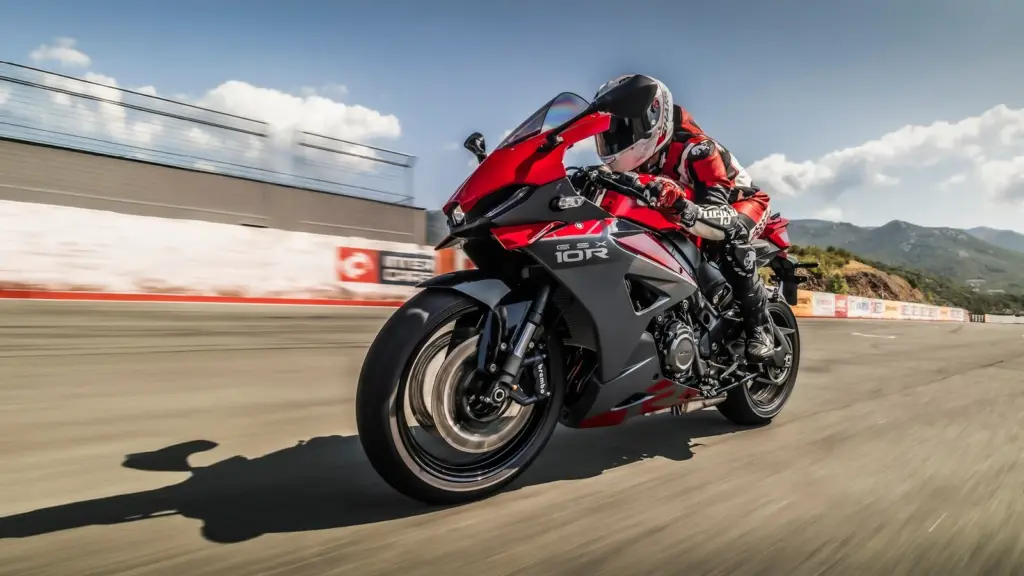
Blue, red or black, with wings up front
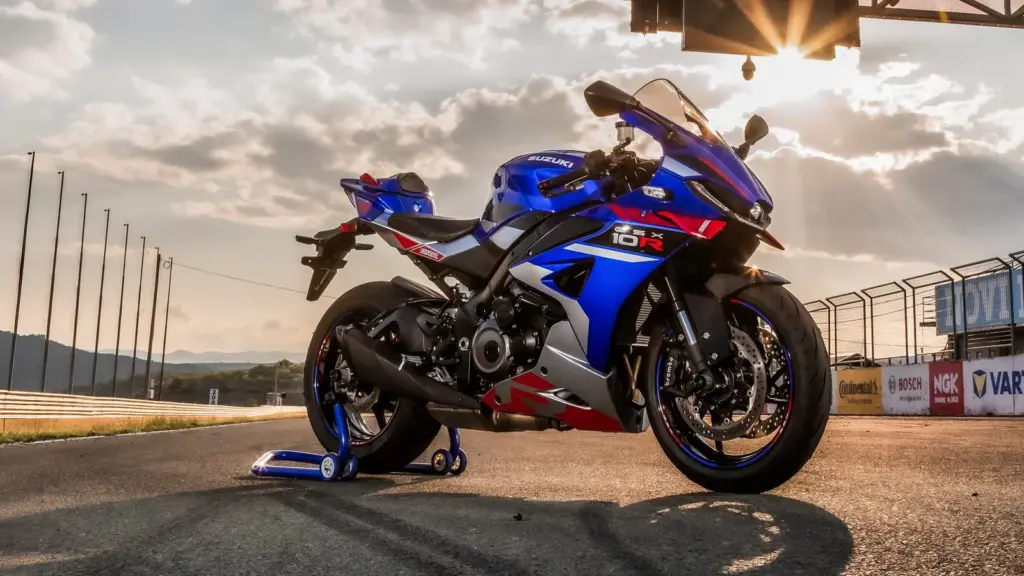
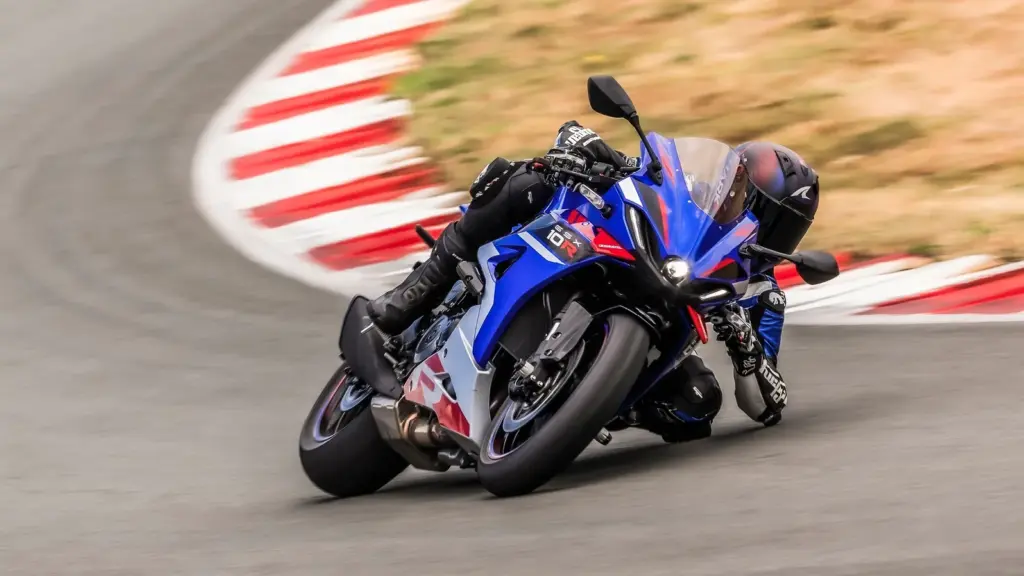
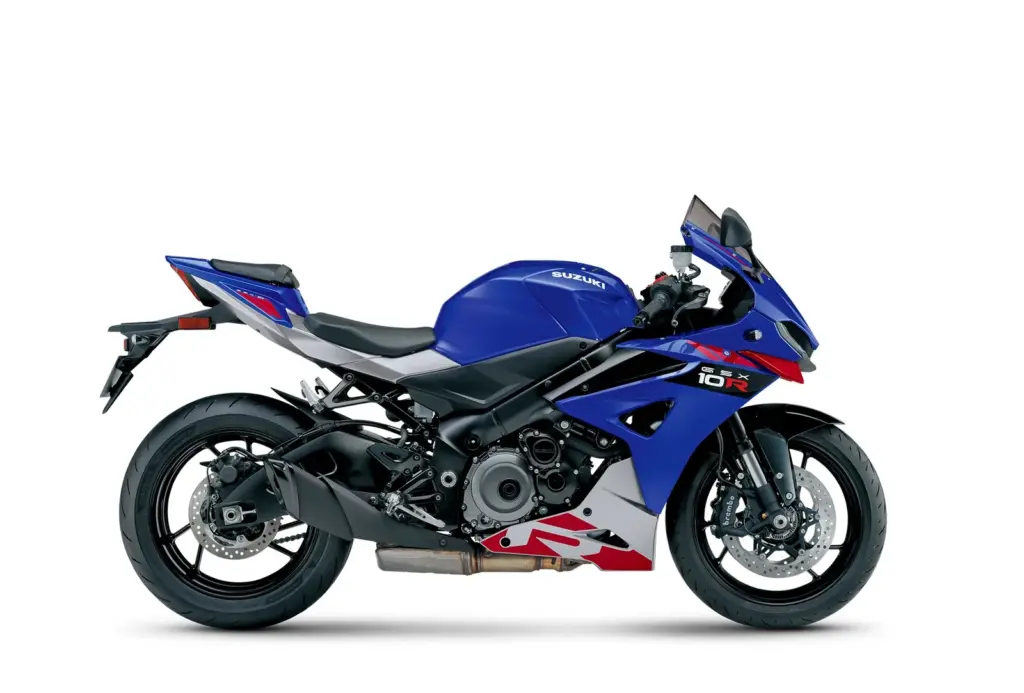
The styling nods at the GSX-R, with similar LED running lights and front air intakes. The fairing was refined in the wind tunnel and carries discreet winglets, and a rounded screen gives your helmet room when you tuck in. A tucked rider behind that screen at 160 km/h is not something we can judge from a press photo, but the intention is clear: this is a bike for covering distance at speed.
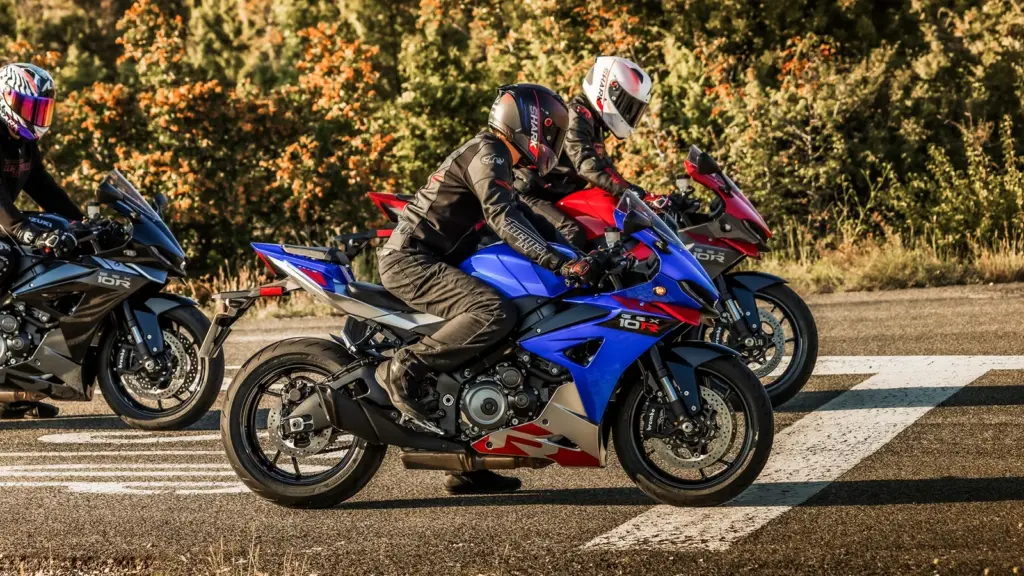
There are three colour schemes: Pearl Vigor Blue and Metallic Mystic Silver with red accents, Pearl Pulse Red with Solid Iron Grey, and Glass Sparkle Black with Metallic Galaxy Grey.
Summer 2027, and a price still to come
The GSX-10R reaches UK dealers in summer 2027, a season after the SV-7S naked bike Suzuki revealed alongside it (the rest of the show is in our EICMA 2026 round-up). Suzuki has not announced it for South Africa or given a local price, and a UK date does not guarantee ours. Pricing will decide a great deal. If Suzuki can bring it in at a level clearly below the superbike class, it has an obvious audience here: riders who want a proper sports bike for the circuit day and the breakfast run, without paying for performance they cannot use.
That audience is large. South Africa has a keen track day community, a long list of scenic passes and a culture of riding out to meet friends, and few of those riders are ever going to need 200 hp. They need a bike that is fun at the limit and civilised everywhere else, with electronics that make a bad moment less costly. On paper, the GSX-10R is exactly that.