
Share your love
The SV650 Lives Again: Suzuki’s SV-7S Keeps the Old Magic and Adds the Tech
Suzuki's new SV-7S brings back the SV650 recipe: the 645cc V-twin with 72 hp, ride-by-wire, traction control, a quickshifter and a 785 mm seat. Full details.
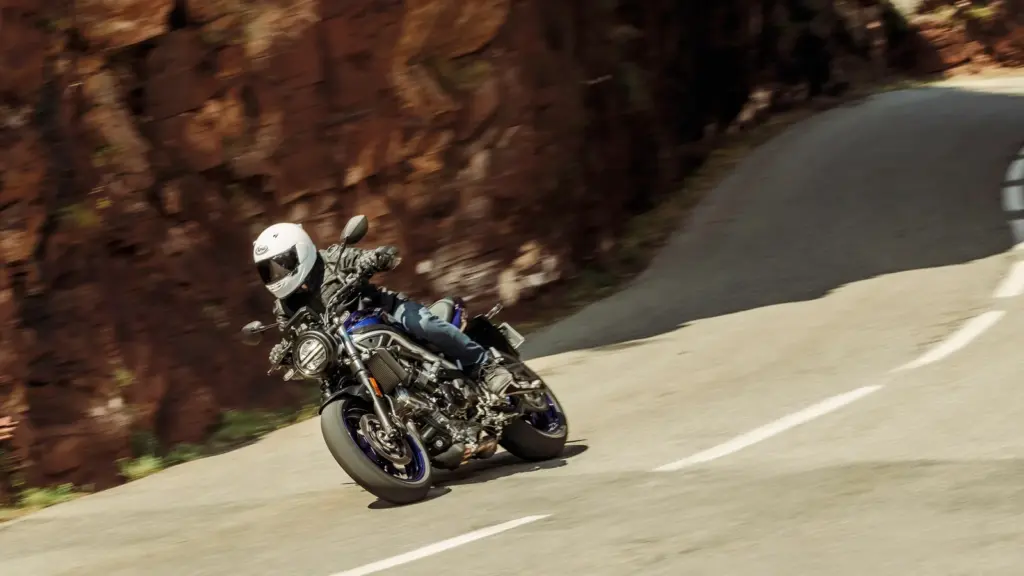
Ask a room full of riders what they learned on, and sooner or later someone will say SV650. Suzuki launched it in 1999 as an affordable, fun middleweight naked with a characterful V-twin, and it stayed on sale in one form or another until 2025. In between it became the first big bike for thousands of people, a favourite of club racers and, for a surprising number of owners, the bike they simply never sold. Visordown notes that in 2000 it was the second biggest selling bike in Europe, behind only the Bandit.
Then it went quiet, and plenty of riders quietly hoped it would return. At EICMA in Milan on 3 November, one of the reveals we cover in our EICMA 2026 round-up, Suzuki answered with the SV-7S. For anyone choosing a first big bike, the question is simple: does the new one deserve the old affection, and what has Suzuki added that makes it a better place to start?
Why people kept their SVs for years
The original recipe was modest. Visordown’s look back at the 1999 bike describes an unfaired SV650N and a half-faired SV650S, 189 kg wet with an 800 mm seat, pitched as an affordable, unintimidating first big bike. Wikipedia adds that its low price and sweet handling made it popular with racers, which helped revive lightweight twins classes in North America.
That combination is the whole secret, and it is worth spelling out for anyone who has only ridden bigger, angrier machines. A bike that is light, forgiving and cheap enough to ride hard without worrying teaches you more than a faster one ever will. Our view is that it is also why owners hung on to theirs: nothing about it ever felt like a bike you needed to graduate from. You could commute on it along the N1 on Monday, take it over a mountain pass on Saturday, and not feel short-changed on either.
Suzuki’s own wording for the SV-7S carries the same idea. The company describes a bike that is “easy to ride, hard to forget”, which is marketing language, but it happens to be a fair summary of what the SV was always good at.
The V-twin Suzuki refused to mess with
The heart of the SV-7S is the same 645cc, 90-degree V-twin, an engine Suzuki says has now been fitted to more than half a million motorcycles since 1999. It came back to Europe earlier this year in the SV-7GX crossover, and in the SV-7S it makes 72 hp (54 kW) at 8,500 rpm and 64 Nm at 6,800 rpm. Suzuki quotes 73 PS, and the hp figure is the conversion.
The sensible engineering stays. Suzuki’s SCEM cylinder plating and oil-jet piston cooling carry over, which is good news for anyone buying with long-term ownership in mind. What changes is the detail work: new transmission gears, a new magneto, revised intake and electronic throttle bodies, and a new catalytic converter to meet Euro 5+ rules. Visordown also notes a 2-into-1 exhaust.
The downdraft intake places the airbox directly under the fuel tank, which keeps the bike slim and the seat low. Just as important is the way the power arrives: strong low and midrange pull with a lively top end. In plain riding terms, that means you can leave it in a gear and let the torque do the work when a bakkie ahead of you slows for a speed trap, rather than stirring the gearbox every few seconds. On the Highveld, where thinner air takes a bite out of any naturally aspirated engine, a motor that pulls from low revs is the one you want. We have not ridden the SV-7S, so that last point is expectation, not experience.
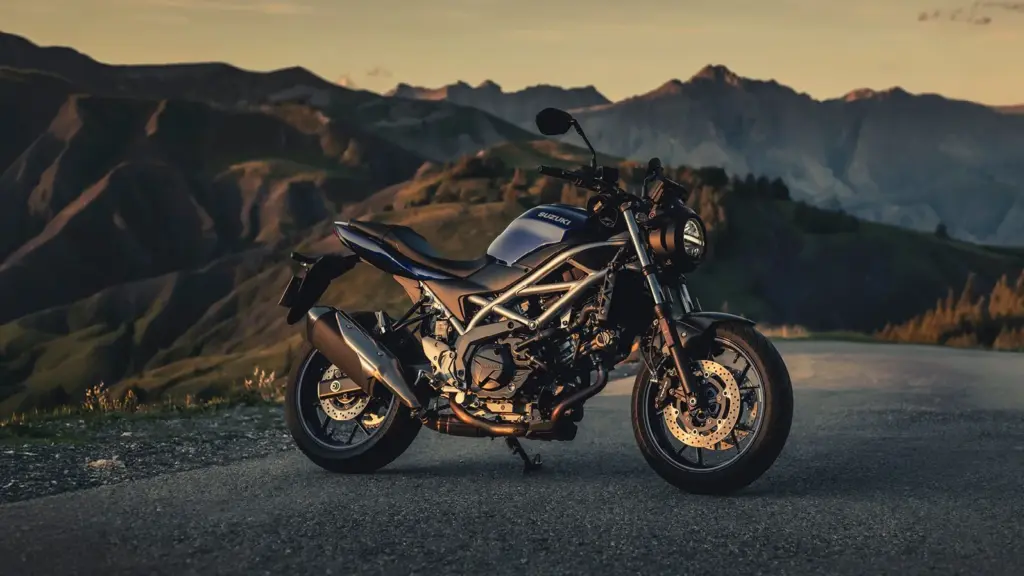
The new bits a learner will actually feel
This is where the SV-7S leaves the old bike behind. A new wiring loom and a ride-by-wire throttle bring three power modes. A and B both give full power, with B softening the delivery, while C softens the throttle further and caps output at about 60 hp (45 kW). Visordown points out that C suits riders on restricted licences, and notes that switching modes returns the bike to full power, so it is a confidence setting rather than a locked limiter. For a nervous rider on a greasy road during a Highveld afternoon storm, that is exactly the right kind of safety net.
There are three levels of traction control, which Visordown says can also be switched off, and a two-way quickshifter as standard. Suzuki adds Easy Start and Low RPM Assist, which raises the revs slightly as you let the clutch out to help prevent stalling. Every new rider has stalled at a robot with a taxi closing in behind, so this is the feature we expect to be quietly appreciated far more than any headline number. Two-channel ABS is fitted.
A 4.2-inch colour TFT screen connects to your phone through Suzuki’s app, which Visordown names as Ride Connect+, for turn-by-turn navigation, weather and notifications. Out on a long road, with the next fuel stop a long way off, having the route in front of you without a phone strapped to the bars is no small thing.
For a newer rider the list makes the SV-7S a far friendlier bike than the old SV650. For an experienced one, the quickshifter alone will be reason enough to look.
A 200 kg bike with a low 785 mm seat
The SV-7S keeps the proven steel trellis frame, now with wider tapered aluminium handlebars for more leverage and a more natural riding position. The seat sits at 785 mm, which Suzuki calls class leading, and Visordown lists the SV-7GX at 795 mm and its SV650 review gives 800 mm for the first bike, so the SV-7S sits lower than both. Shorter riders should find it easier to reach the ground, which anyone returning to riding after a break will appreciate in the first car park.
The redesigned tank still holds 14 litres while saving weight and making room for the new electronics. Visordown quotes a claimed 4.1 litres per 100 km, which by our arithmetic works out to roughly 340 km from a full tank on paper. Real life will be less, and on a Karoo run where towns are far apart, it is worth knowing before you set off.
Suspension settings have been revised for comfort while keeping enough control for spirited riding, and the bike runs Dunlop Roadsmart III tyres. Visordown, reporting the full specification, lists a 41 mm fork with 125 mm of travel, a rear shock with 129 mm and seven-step preload adjustment, twin 290 mm front discs with four-piston calipers and a kerb weight of 200 kg, about 11 kg less than the GX. That is modest travel, so the comfort work will be put to the test by South African potholes, and the adjustable preload could come in handy with a passenger or luggage on board.
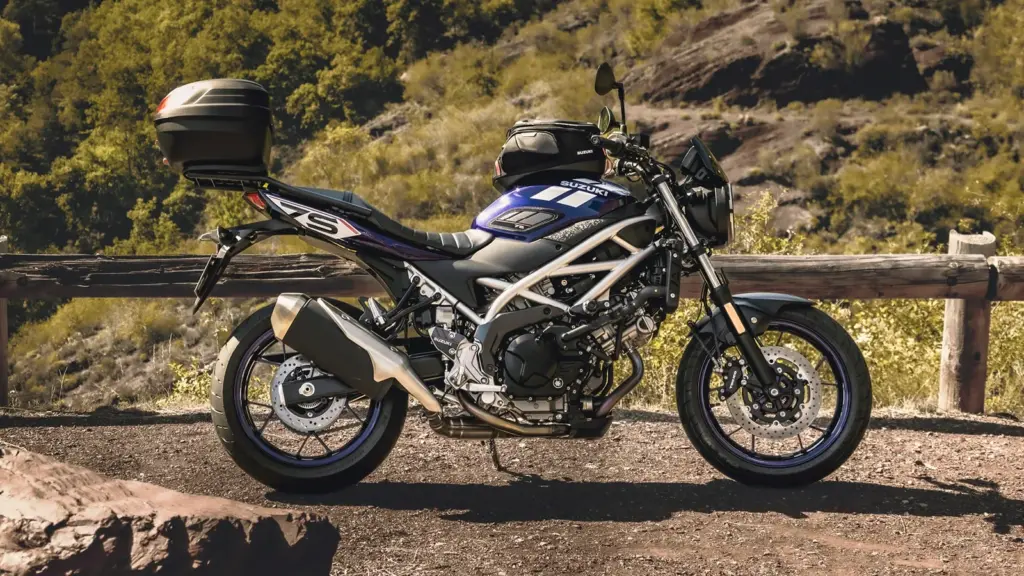
Looks that still say SV
The styling stays true to the SV, with a reshaped tank behind a new round LED headlight, LED indicators, a slim seat unit and an exposed trellis frame. Suzuki’s own line is that classic SV styling evolves with the 7S, and from the pictures we agree: it looks like an SV that has been to a good tailor rather than a stranger wearing the name.
There are three colour schemes. Pearl Suzuki Deep Blue sits on a Matt Sword Silver frame, as does a Matt Sword Silver and Glass Sparkle Black scheme, with Pearl Suzuki Deep Blue wheels on both silver-frame versions. The third is Glass Sparkle Black with colour-matched wheels on a grey frame.
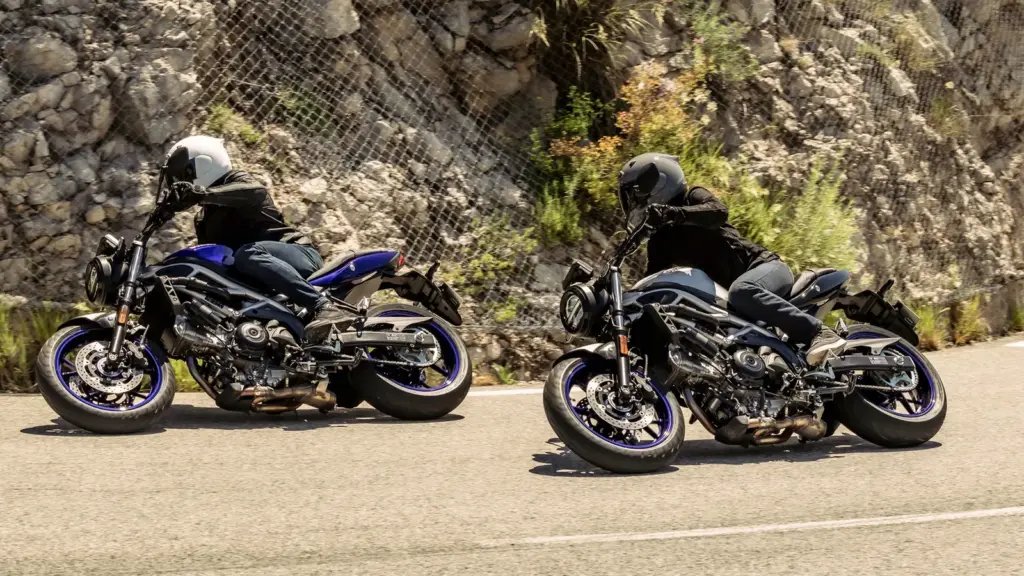
A two-way quickshifter and three-level traction control are standard. Image: Suzuki 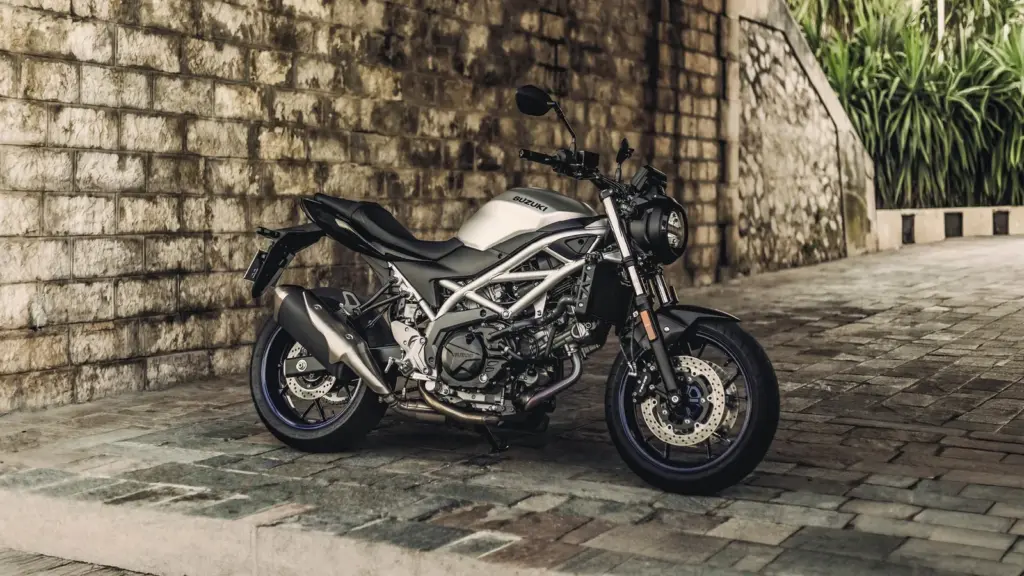
The exposed trellis frame and round LED headlight keep the classic SV look. Image: Suzuki 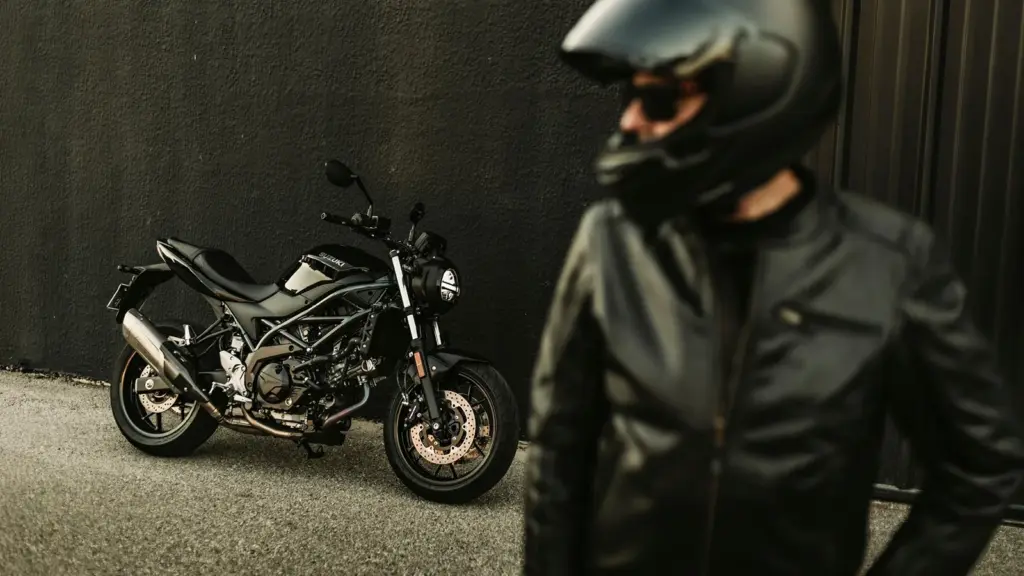
The Glass Sparkle Black version, on a grey frame. Image: Suzuki 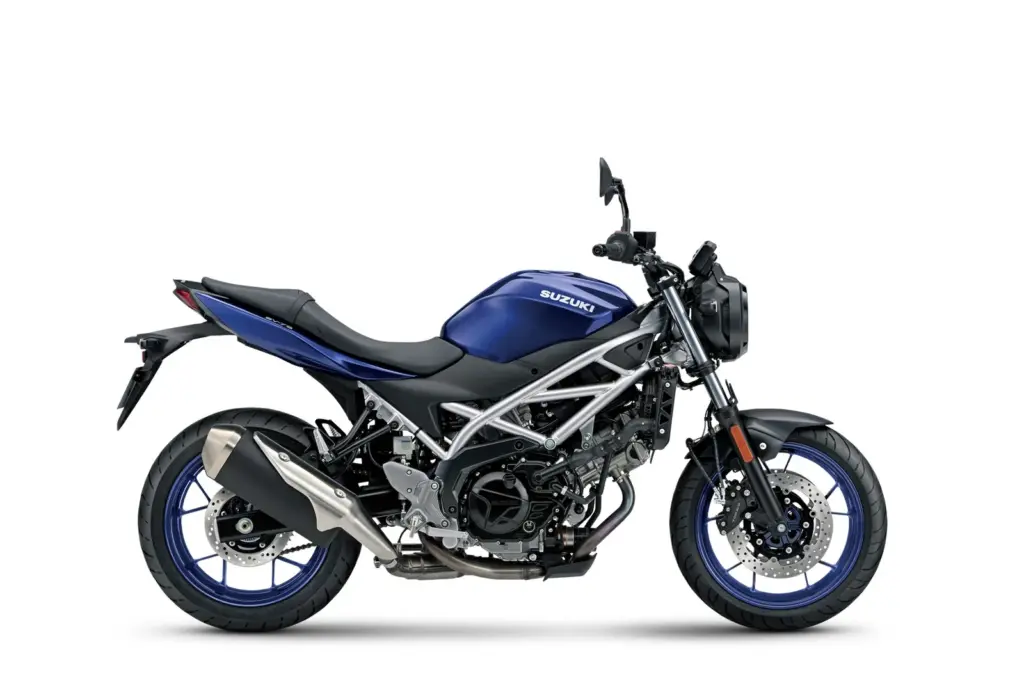
Pearl Suzuki Deep Blue on a Matt Sword Silver frame. Image: Suzuki 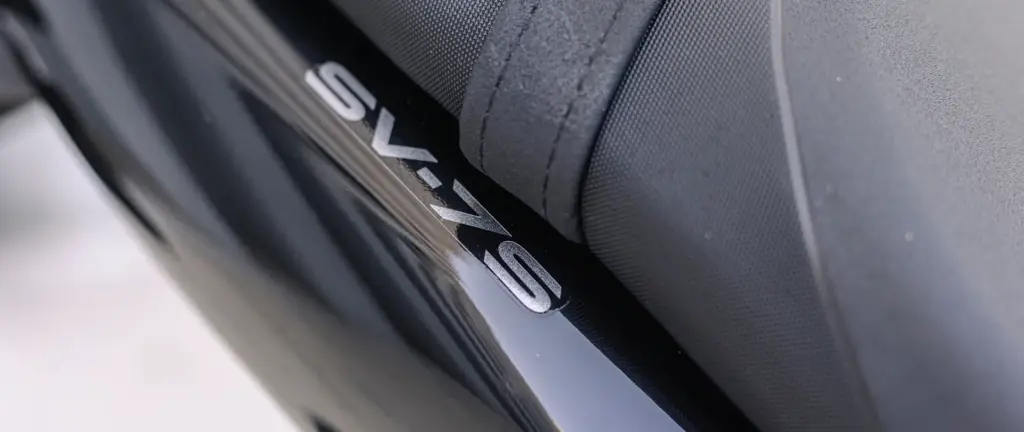
A 785 mm seat that Suzuki calls class leading. Image: Suzuki
Next to the Yamaha MT-07
Any first-big-bike shortlist has to include the Yamaha MT-07, and on paper the two are remarkably close. Total Motorcycle lists the 2026 MT-07 at a claimed 73.4 PS from its 689cc parallel twin, roughly 72 hp (54 kW), with a 183 kg wet weight, an 805 mm seat, a 5-inch TFT and switchable traction control. The SV-7S matches it on power and undercuts it on seat height.
The weights come from different outlets, one quoting a kerb figure and the other a wet figure, so check them against each other on a test ride rather than reading much into the gap. The real difference is character: a V-twin and a parallel twin do not sound or feel the same when you open the throttle. That is a showroom decision, and one worth making on a test ride rather than a spec sheet.
The nearest price guide comes from Suzuki UK, where the SV-7GX that shares this engine starts at £6,999, and £7,399 for the coloured versions with graphics and matched wheels. Suzuki has not given a UK price for the SV-7S, and as the simpler, more traditional naked it may well land below the GX. That is speculation, not a figure.
Spring 2027, and a rand price still to come
The SV-7S reaches Suzuki dealers in the UK in spring 2027, and Suzuki UK’s SV-7S page lists no price yet and offers a Reserve now button with a deposit. Suzuki has not announced the bike for South Africa or given a local price. That gap matters, because pricing will decide whether this is the sensible first big bike we think it could be.
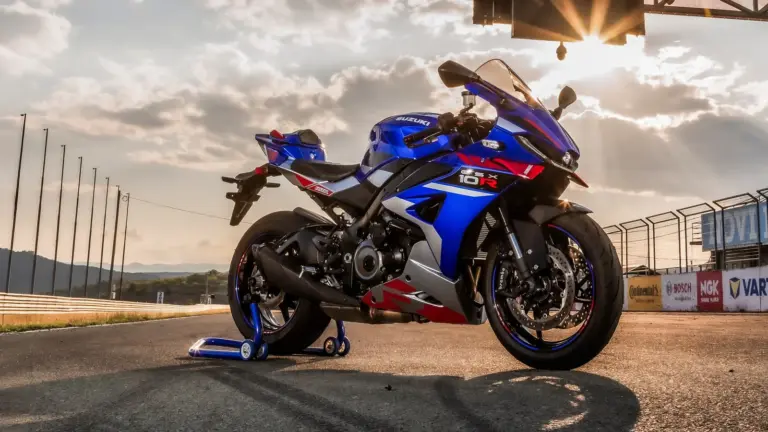
What we can say is that the shape of it suits this country. A light, low, proven naked with a forgiving power mode, a quickshifter and traction control is the sort of motorcycle that many South African riders stepping up from a small bike are looking for, and the SV’s reputation for reliability counts for a great deal where the nearest dealer can be a long way off. Suzuki also showed the GSX-10R sports bike in Milan, but that is a very different conversation.
If the price is right, the SV-7S could do what its predecessor did for a generation: be the bike that teaches you to ride well, and that you cannot quite bring yourself to sell.