
Share your love
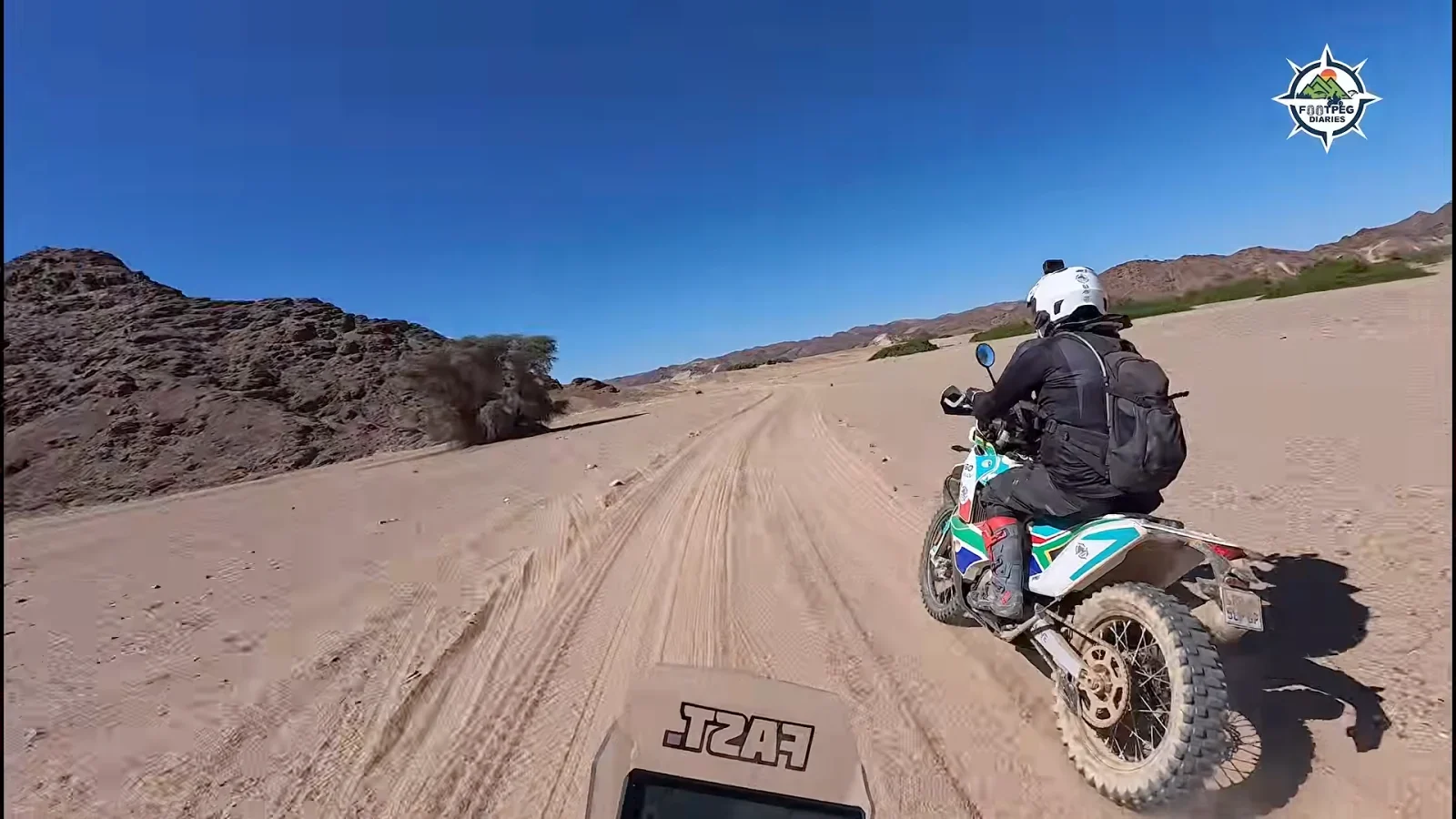
Riding Namibia’s Dry Riverbeds: What Rocks & Riverbeds Taught Us – Footpeg Diaries
Thirteen men, two support vehicles and about 500 km of dry riverbeds from the Kunene to Hentiesbaai: Footpeg Diaries on Van Zyl's Pass, desert elephants, lion country and broken bikes.
It started the way the best rides do, one evening around a campfire with a promise and a little Dutch courage. On a bike trip through Eswatini a few months earlier, one of the guys shouted “Let’s go find somer desert riverbeds!”, and before anyone had thought it through, the whole group had signed up.
Keeping that promise meant almost 2,000 km by car and trailer, beginning on a cold, dark winter’s morning with a 17-hour drive to Windhoek, and then another 1,000 km on the bikes before the real adventure could start on the Kunene River, the border between Namibia and Angola. In a Windhoek pub we met the rest of the guys from across Southern Africa, old friends and new, and the first team-building session was soon well under way. That matters, because once you’ve ridden with these reckless old men, you’re in it for the long run.
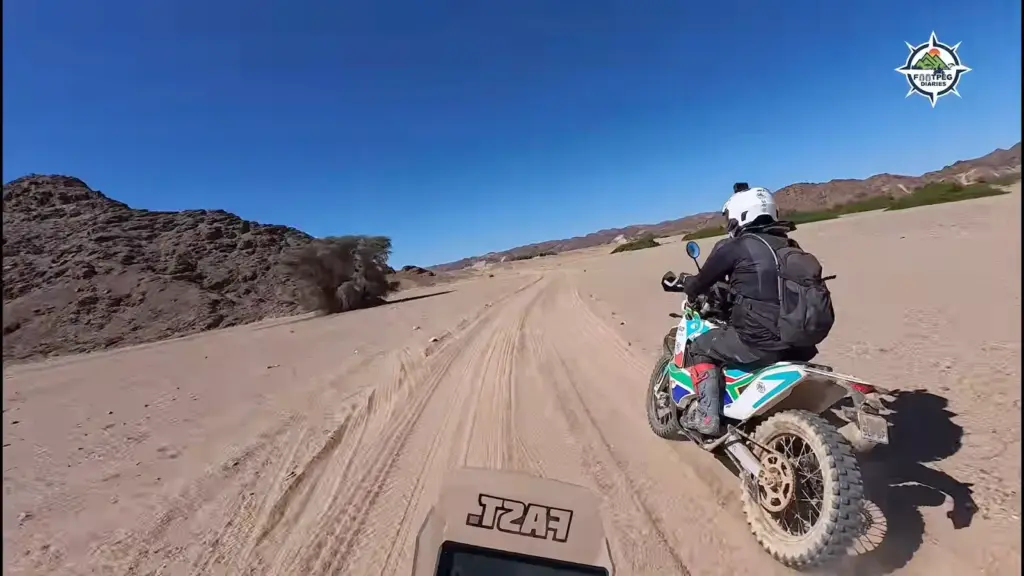
The plan for Rocks & Riverbeds was simple on paper: ride as many of the dry riverbeds of Kaokoland and Damaraland as we could, from the Kunene all the way south along the Atlantic Coast towards Hentiesbaai. It added up to eleven days in the desert, more than 500 km of riding in riverbeds alone, and nearly two weeks away from home.
Packing too much
This trip was going to be different. There will be other trips where everything we own is strapped to the bikes again, but this time we came on lighter, rally-style machines with nothing on them, and let two fully loaded support vehicles, a Land Cruiser and a Hilux, carry the camping gear, the food and, yes, the beer.
Henry and I were on KOVE 450 Rallys. Rickus, who led most of our navigation, had a brand-new KOVE 800 Rally. Danie brought his T7, Paul a big 950, and Adrian, Dewald and Gene were on 500s. Three of the bikes had come up through Botswana and been sprayed for foot-and-mouth disease on the way, so they arrived beautifully clean. As one of the guys put it, we were going to the desert, so naturally they would stay clean the whole time.
We towed the bikes one last time, a little over 200 km to Usakos, then offloaded them and packed the trucks for eleven days in the desert. The packing raised a few eyebrows. We had said “bring what you can fit on your bike”, and judging by some of the “small bags”, a few of the guys had taken that loosely. Let’s be honest about it: this trip was never about being rough and tough. It was about having fun. Yes, there was a beer truck. Yes, there was nothing on our bikes. That was the whole point.
A reality check at the first filling station
After months of planning we finally saddled up and rode to the nearest filling station, feeling like proper adventurers in our clean gear and expensive equipment, feeling confident that my new Leatt-sponsored riding gear would protect me like a Power Ranger heading into a deadly alien world. Then we met a Japanese rider who had been on the road for two years. He had started in Mongolia, crossed to Portugal and Spain, taken the ferry to Morocco and ridden all the way down Africa. Next was South Africa, and after that South America: he was riding around the world. When we asked about the biggest problem on the road, it turned out to be the one he had right then: a broken spoke. The road from the Spitzkoppe was very bad, and he had to go back to Windhoek to fix it.
I can’t think of a better way for the universe to remind us that we were thirteen middle-aged men on a short motorcycle holiday with two fully loaded support vehicles. There is nothing to be ashamed of in that. But it made us realise how fortunate we are to play these adventure games at all, and to appreciate every moment, right from the first kilometre.
Throttle therapy in Damaraland
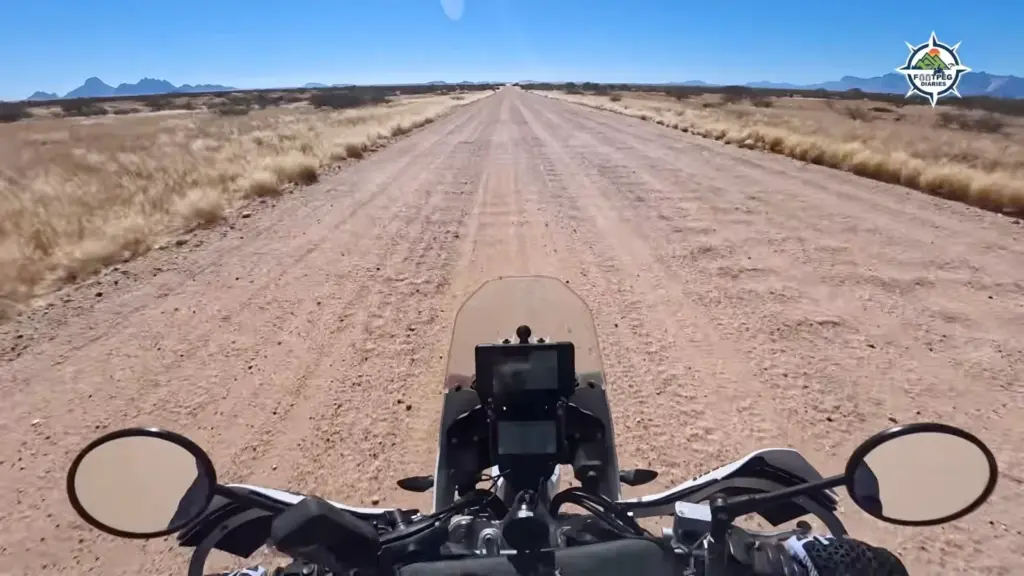
Our first stop was White Lady Lodge at the foot of the Brandberg, and the road there took us past the peaks of the Spitzkoppe on wide-open gravel and sand. A few of us were on new bikes, and new bikes bring first-ride jitters. The cure is a generous dose of throttle therapy, and everyone was more than willing to take their medicine. A day or two before the trip, Rickus had fitted heavier springs to his brand new Kove 800 Rally to suit his heavier bulk, and he hadn’t had time to test them. This trip would be the test bed.
In the mining town of Uis, Rickus led us up a sandy hill scored with cross ruts dug by spinning 4x4s, which some of the guys found a little tricky. The effort was worth it. From the top of the biggest mine dump in the area we watched the sun start to set over Damaraland, then rolled back down for a splash and dash at the filling station and one of the prettiest sunset rides I’ve done in a very long time. We camped under big camelthorn trees in a dry riverbed, and it became one of those golden evenings where old friends sit around the fire until late into the starlit night, catching up on news from home and talking about the challenges ahead on our very mixed pack of machines.
Into Kaokoland
The night was bitterly cold, and it still hadn’t warmed up when we broke camp. Before we left, one of the guys told the camera about something said earlier that morning: this would probably be the last time some of us rode this road, because it isn’t a road everyone rides. It got him thinking about what adventure riding is, how it takes you to places you’ve longed for, and how you never know if it’s the last time you’ll be there. “That makes you think about every single second, and how precious that is,” he said. “So yeah, today is going to be precious.”
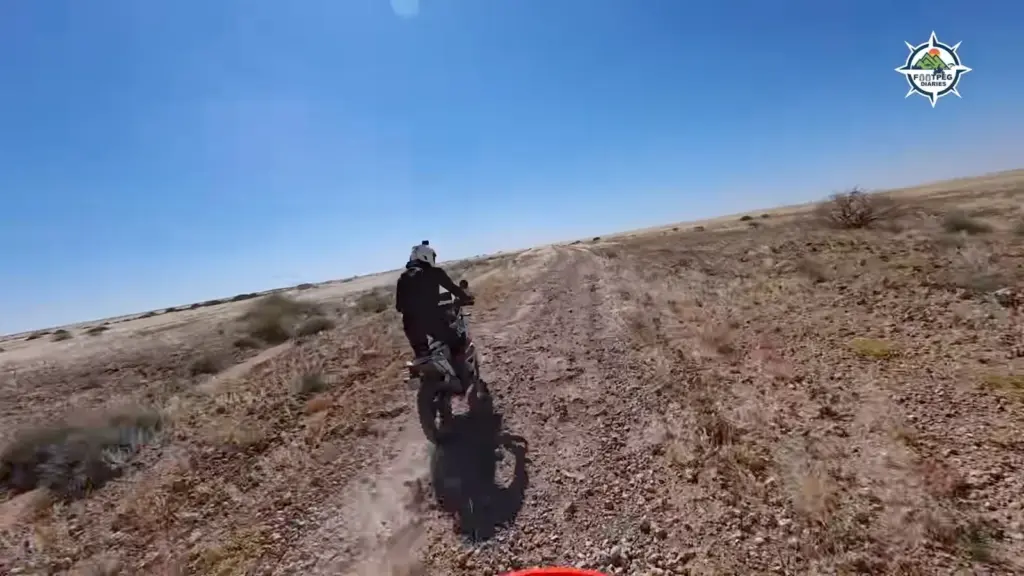
First, though, there were mechanicals to sort out, most notably the clutch master cylinder on Dewald’s 500, a brand-new second-hand bargain that (apparently) had never been raced. After some limited mechanical success we took on the first real sandy track of the tour, a two-hour morning tester of navigation, sand riding and group dynamics, and a wake-up call for the ten days ahead. Rickus led us north across the dry Ugab riverbed, a river I suspected we would see again before the trip was over, and on into the sandy, rocky emptiness of Damaraland. A two-spoor track across the plains, with its mix of rock, hard surface and sand, made it very hard not to twist the throttle a little further. Back on the gravel highway north, we fitted in a roadside stop for Paul to replace a broken battery cable, refuelled in Khorixas and had plain sailing to the lodge pool at Kamanjab. The first few days were deliberately fast and open, because the aim was to get north quickly. The real technical riding would only begin in the Kunene valley along the Angolan border. Adrian had told me an old wives’ tale about mousses collapsing at speed. Clearly, part of a cunning plan to get me to slow down. Needless to say, I did the total opposite and tried my level best to stay ahead of him.
Mousses don’t do 130 on gravel
On the morning of day four, as usual, the coffee and the field repairs started well before sunrise. We had been running from civilisation for four days, with a lot of riding and a lot of fixing: air filters, fuel pumps and oil leaks. Some of the air filters were filthy already. The plan was to ride from Kamanjab to Opuwo, but the odds were not in my favour. My rear mousse gave up. It turns out mousses don’t do 130 km/h on gravel. I thought it was only gravel, so it would be fine. It was not fine. By sheer luck it happened right in front of a local tyre shop, and I swapped the rear mousse for a tube on the spot.
The day’s route ran along a long stretch of tar on the edge of Etosha National Park, then a short section of gravel and more dull tar to our overnight stop just before Opuwo, the last major frontier town. After an hour of monotonous tar, boredom got the better of the guys. They joked around to stay awake, and some rode next to the road just to amuse themselves. It was all good fun until the Engelsman overcooked it into a huge washout at a drainage pipe, almost bending his 500, and himself, before the real exciting part of the trip even started. When we finally found some gravel, everybody gave it gas. Then it was back onto the tar and straight into a roadblock, and the open arms of the law. The foreign livery on my bike drew some unwanted attention from the local armed forces, and I was a little worried until I realised the officer only wanted a light.
Our overnight stop, Kaoko Mopane Lodge, had a campsite, pools and a bar so good that we decided to make it a Footpeg franchise. Adrian rolled in having run out of petrol with fuel still in his KTM 500’s tank, because the pickup sits above the bottom of the tank and the aftermarket suction pipe that fixes it was still on his shopping list. After a swim, the afternoon eased into cold refreshments and delicious curried lamb sosaties made for the trip by Gene’s wives, then sundowners at the bar and a heated debate about red wine with ice. One of the guys insisted that red wine must be enjoyed at room temperature. But the Engelsman pointed out that room temperature in France is a lot lower than room temperature in northern Namibia.
Day five began before sunrise, like every day did, with the cacophony of snoring old men giving way to the clatter of tools as Rickus still made more adjustments to his new Kove 800 Rally’s suspension. Just before we left, I noticed that my front mousse had gone soft as well. I have to confess I had been very arrogant before the trip. I told everyone I wouldn’t be fixing any bloody flat tyres; I would just ride straight past them, because I had mousses. And there I was, the first one with mousses needing a tyre repair, and now it was number two. The mousses were expertly fitted back in South Africa by the KOVE team that also fitted the rally mousses in Henry’s 450 Rally, the best mousses on the market, and his were still fine. I blame the bike… if it didn’t make me smile every time I raced over the horizon at speed, I would have slowed down before I cooked them. So clearly, it was the bike’s fault.
The last fuel pump and the Dorslandtrek
Opuwo was our last proper fuel stop for the foreseeable future. From there on it would be roadside cans and whatever the vehicles could carry for the best part of 1,000 km. With tubes in both tyres I could finally pick up the pace and enjoy the nimble little rally bike on the fast gravel to Swartbooisdrift.
As the Kunene came into view in the valley below, we turned off to the Dorslandtrek Memorial. It remembers a tragic series of journeys by Boer settlers from South Africa between 1874 and 1881. Three separate trek groups left the old Transvaal, driven by resistance to progressive authority, ultra-conservative religious views and fear of higher taxes. After leadership disputes, years of wandering and devastating losses to malaria, drought and conflict with indigenous communities, some settled for a while at Swartbooisdrift on the banks of the Kunene. In 1880 the first groups were welcomed across the river into Angola by the Portuguese, and many eventually came back from 1928 onwards, still never having found their promised land. I couldn’t help being amazed at how stubborn and single-minded they must have been to drag their families back and forth across those unforgiving plains.
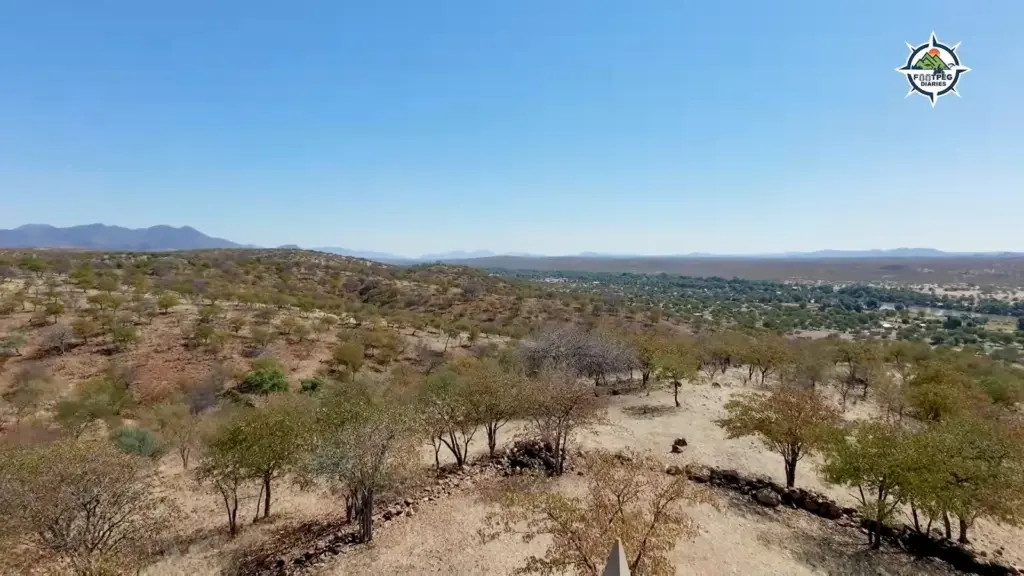
Like those wandering souls, we followed a dry tributary down to the river in search of our own shady resting tree. Danie and I walked down to the water’s edge, and the talk turned to whether this might be the first and the last time we would see the Kunene. Danie also showed me the fruit of the makalani palm, whose hard pit is what gets carved into the souvenirs.
A flooded riverbed and the road to Epupa
After lunch, Rickus went looking for our first riverbed of the trip. We left the main road along the ridge and followed a secondary track across the Kunene’s floodplain, towards the water’s edge. Northern Namibia had just had its best rainy season in decades, and the river was running so high that much of the track was under water. We sent Dewald ahead to test the mud, then followed a little too closely behind Paul and his big 950. With every metre the track demanded more commitment and drained more energy, and the riders on the big bikes were the first to struggle as the rocks gave way to deep, soft sand. After more than an hour of rocks, sandbanks, climbs and washes, we had covered about 8 km. We called it and headed for the gravel road along the river.
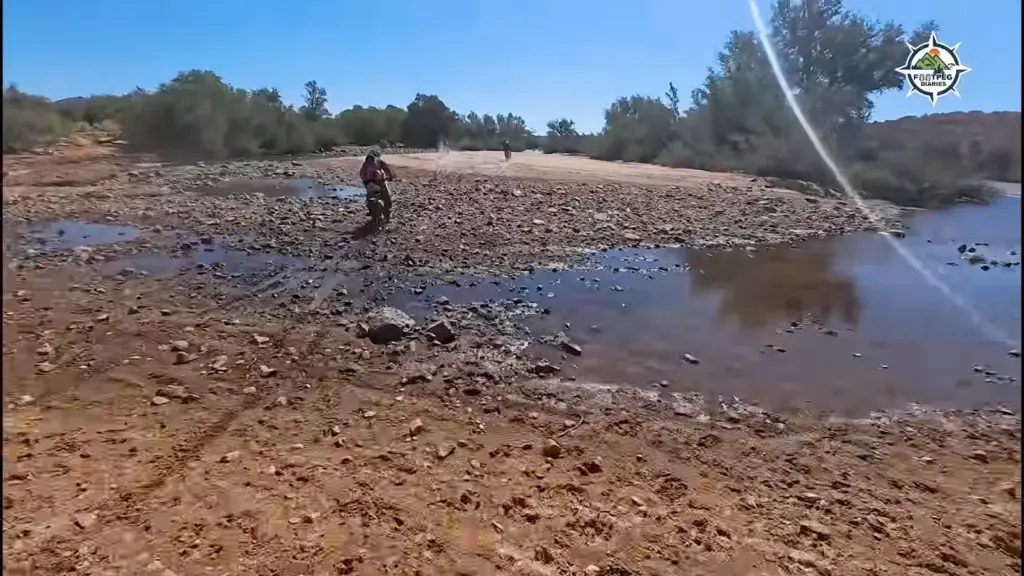
That road turned out to be a gift: palm trees, soft sand, a fast-flowing river and plenty of little rocks to bounce over. With about 80 km left to our camp at Epupa Falls, we were all giving it some stick. The road hugs the river, constantly crossing sandy tributaries, climbing away into the hills and dropping back down to the Kunene, through a barren landscape made unexpectedly green by the rains. At one stop, while Rickus laboured away at a punctured front tyre, one of Adrian’s old habits resurfaced: lounging in the dust. It was the first sign of a comfortable routine that would grow to impressive proportions later in the tour.
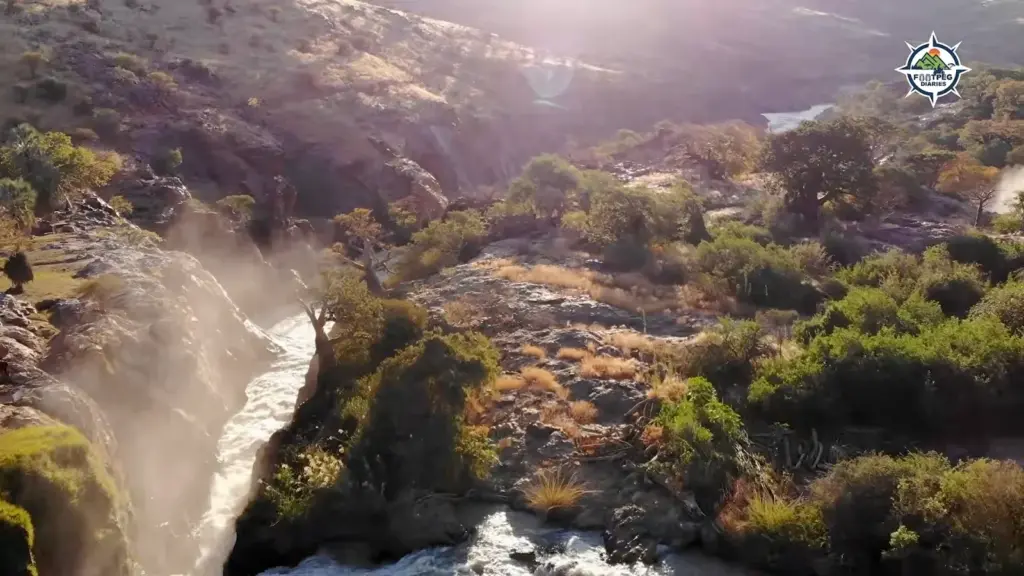
The final stretch to Epupa was an epic adventure track, with high-speed dips, jumps and spectacular views as the road snaked through the rocky hillside. Arriving at Epupa Falls Camp site, We went straight for the swimming pool, did some much-needed maintenance before dark, and settled in for the night beside the falls, where baobab trees cling to the rock ledges in a way that defies belief. Tomorrow was going to be a watershed day.
Van Zyl’s Pass
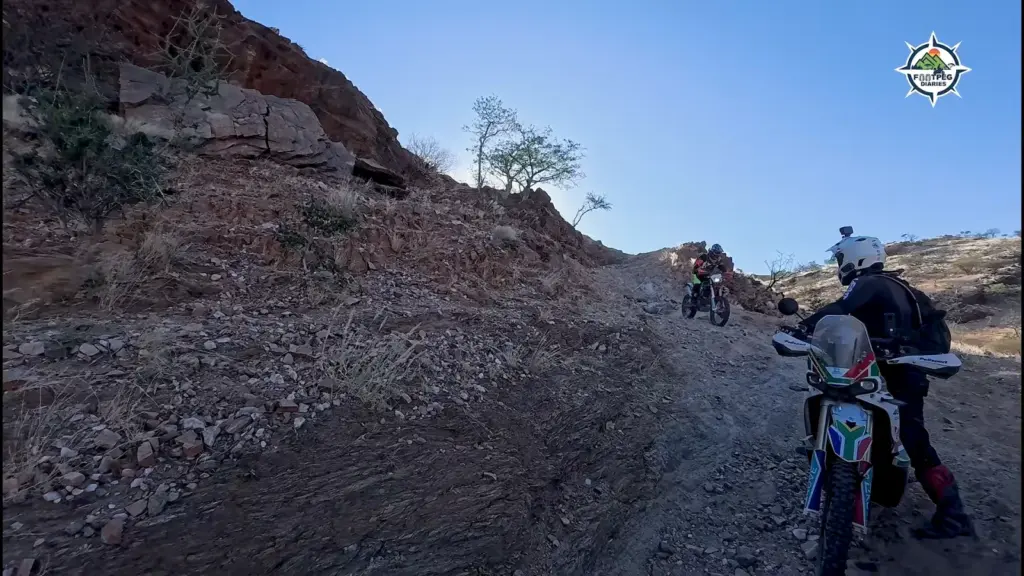
Finishing day six before dark would have challenged even a small group of strong, experienced riders. For a group our size it was always going to be nearly impossible. We started with an easy 70 km of open gravel to Okangwati to look for fuel. We had passed the last fuel station the morning before and didn’t expect another for three days, so from here we relied on container fuel sold from shacks and roadside shops. While re-fueling At Okangwati we made the call that the Land Cruiser would not come down Van Zyl’s Pass. It was so heavily loaded and top-heavy, with its suspension already under strain, that we couldn’t risk it. That was a pity, because the crew had been looking forward to it. Nick would come with us in the Hilux, and the Cruiser would drive around by another route and meet us at Marble Camp that night. Our route would take us over Van Zyl’s into the Marienfluss, past Rooidrom and over Jan Joubert Pass to the campsite at Marble Camp. Van Zyl’s Pass has a fierce reputation, mostly for its steep, legendary step, and we had heard worrying reports about the track leading up to it. The approach crosses washes and dry creek beds, but the day is really about technical rock riding. As one of the guys put it, sometimes you ride a road and think you’ll bring your family back to see how pretty it is, and then you ride the road to Van Zyl’s and realise your wife is going to beat the crap out of you if you put her in vehicle and take her on this road. As soon as the rocks began, exhaustion took its first victim. Paul went down hard over the handlebars. I was pretty sure he had hurt his left hand, but he ignored my question and kept going. Then again, Paul is the kind of guy who would look at an amputation and dismiss it as a minor carpet burn.
And then the real rocks started. The slow riding wore on me, and I kept looking ahead for the Van Zyl’s campsite sign that marks the start of the pass. The first climb into the Otjihipa Mountains pulled no punches. After an hour of relentless rock, we had covered just 7 km. At the viewpoint we did the maths and wondered what we had been thinking: 80 km done and 60 still to go. But then you look out over the Marienfluss stretched out below, and all you can say is “wow”.
Before we could drop into it, we had to get down the step. Three abandoned vehicle wrecks in the valley below are a stark reminder that this is no place for complacency. The rains had left it brutally steep and eroded, like riding down a jagged wall, and the loose rock made braking almost impossible. We were all quietly worried about Paul taking the heaviest bike down with an injured clutch hand. By late afternoon, exhausted and almost four hours behind schedule, we were all at the bottom. One of the guys, who had been there in 2021, reckoned it was gradually getting worse and worse. Were we glad we had sent the Cruiser around? Absolutely. With that load it would have been a nightmare. Even Nick in the Hilux had come through the culverts with centimetres to spare, and the Cruiser would surely have picked up some substantial damage.
Into the Marienfluss, and a night in the dust
Riding into the true Namib, the oldest desert on Earth, we accepted that we would be riding into the night before we reached camp. The sun sank lower over a savannah made unseasonably green by the rain, and it was easy to understand why the Himba regard this land as sacred ground. The ride through it felt deeply moving. As We rode into the sunset through a landscape that at times looked like the surface of Mars, past Rooidrom, we kept pushing on as fast as we could in the dark. We were so focused on keeping our momentum that we barely noticed when we began climbing Jan Joubert Pass.
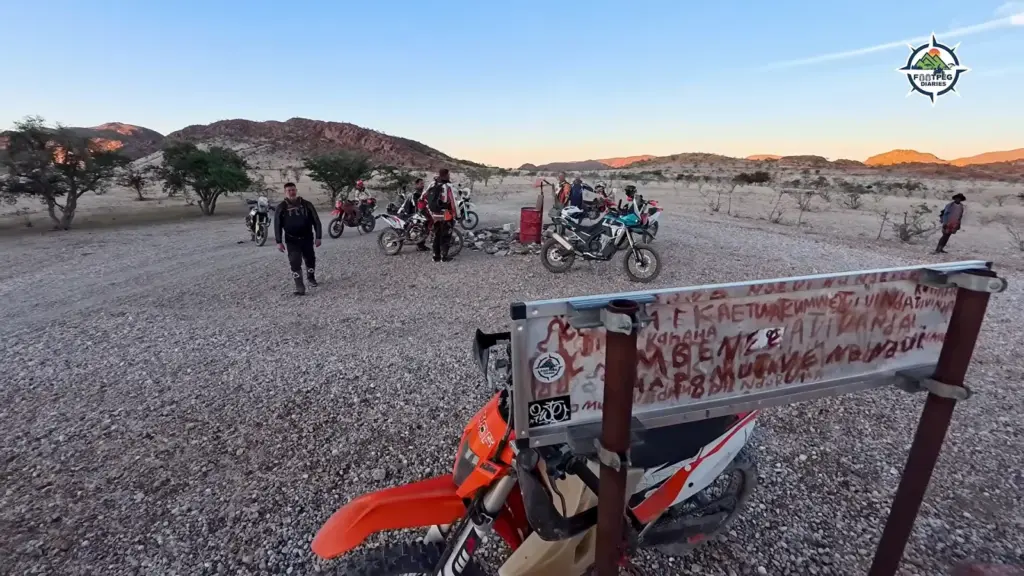
We reached Marble Camp at about eight that evening to find a surprise not waiting for us. The Cruiser had gone to a different campsite and waited there all afternoon. The problem was that it was on the far side of Van Zyl’s, a loop of more than 300 km by road. The bathrooms had no water, but luckily we had the food truck with us. The crew made us dinner, an assortment of refreshing drinks appeared, and then we lay down in the sand. It was a long, freezing night in the dust, with our riding gear, a couple of tarps and one or two shared sleeping bags for warmth. Just before sunrise, the Cruiser rolled in. The crew had driven all night, got stuck in a river at midnight, unpacked everything to get it out and then packed it all back in. We were back together, tired, filthy and aching from a night on the rocks.
Our first riverbeds: the Khumib and the Hoarusib
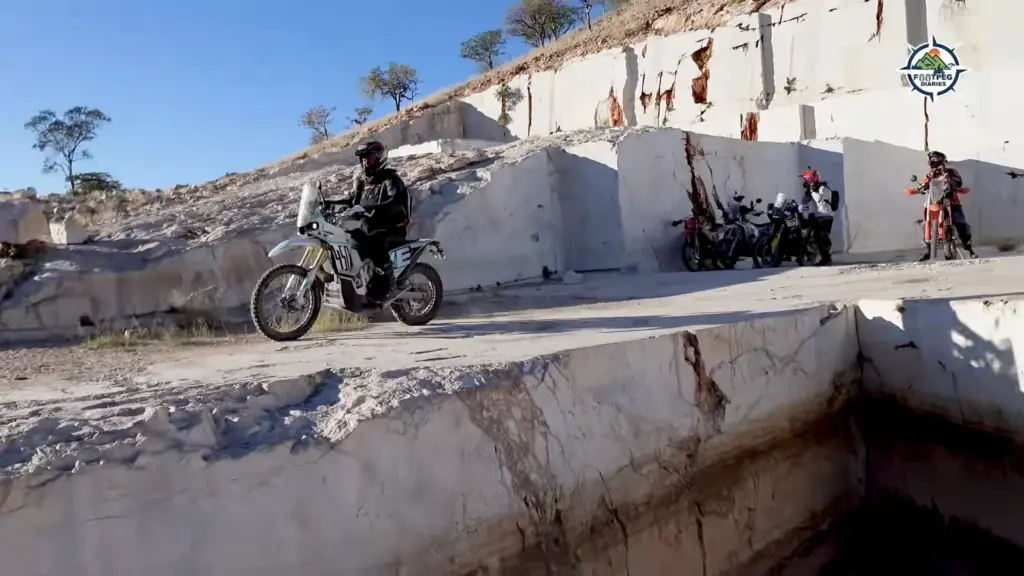
After giving the Cruiser crew an hour of sleep, we made a short detour to the old marble quarry nearby. Finding white marble cuttings in the middle of nowhere felt surreal, as if a melted Salvador Dalí watch might appear at any moment. Before the trip, Rickus had sold this day to us as a rest day of sorts: a relaxed 120 km ride through the desert, with our first dry riverbeds thrown in. Two riverbeds, to be precise. Starting off, I immediately realised that he was lying all along. Along the way we spotted one of the lone men of Kaokoland, part of a series of small statues hidden across the desert. Rumour has it there are about 30 of them, and nobody officially knows who made them. Some of the guys in our group know, and they also know why a few have sadly disappeared in recent times. If you enjoy an Easter egg hunt, Kaokoland is the place to look. We were on a different search, for the coldest fridge within a two-day ride, and luckily that was only a few kilometres away in the little settlement of Orupembe. We took a late-morning siesta in the cool shade of the shop, where Adrian was soon stretched out in the dirt again, and held a quick strategy meeting.
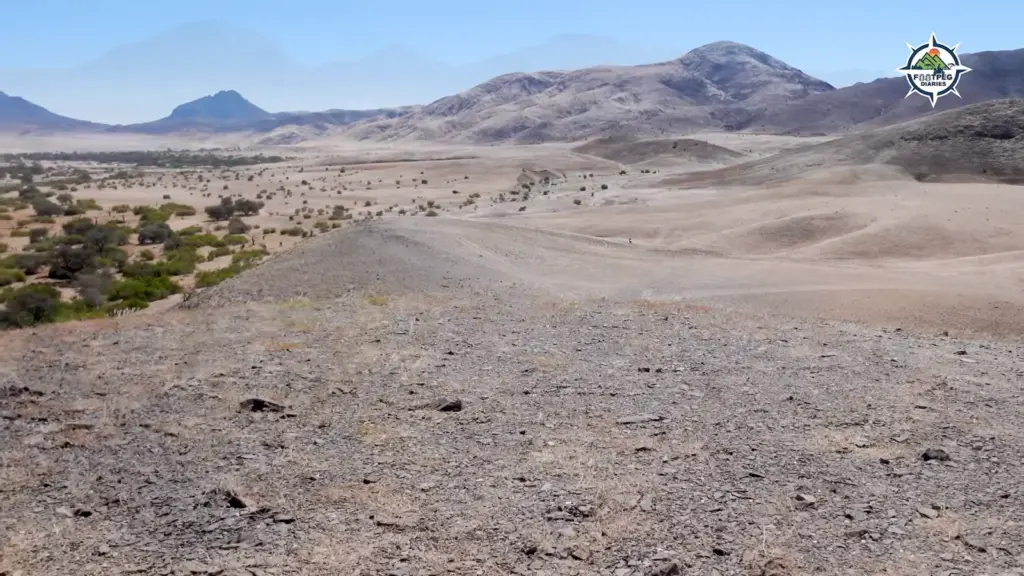
The Khumib riverbed track starts just outside Orupembe, and our first riverbed of the trip called for a small celebration, which turned out not to be that small. A month or two earlier, heavy flash floods had torn through the Khumib, carrying most of the soft sand downstream towards the ocean and leaving scattered rock, exposed ridges and a rougher track than we expected for the next 50 km. Some of the guys made it look easy, even enjoyable. For me it brought the first sign of a problem that would taunt me for the rest of the trip: I stalled the bike and it refused to start again. Luckily there was an open track running alongside the river where I could run-start it, and a few kilometres later we left the riverbed to cross a ridge towards the Hoarusib.
At a viewpoint above the Hoarusib, not far from Puros, the quiet of the desert left a powerful impression. Down in the riverbed, giraffe were moving upstream, so we joined them for the last few kilometres to camp. Just when you think it’s safe to go back into the river, you come across a fairly fresh giraffe carcass: definitely a lion kill. The sighting sped the group up, and with speed comes risk. I dropped my bike in the thick sand but clung to the clutch for dear life. The last thing I wanted was to stall there and spend the night in those thickets with Mufasa sniffing at my tailpipe. By the end of the day we had ridden nearly 70 km of demanding riverbed sand.
That afternoon Adrian serviced his bike in camp and walked us through what he calls his basic standard kit, which turned out to be a lesson in itself (more on that below). It was a warm evening, so we set out our stretchers in the riverbed and hoped that a large group of snoring riders would be enough to keep the hungry lions away. Just to be sure, the guys made plenty of noise around the fire to keep old Yellow Tooth at bay.
One way through the Puros Canyon
The next morning began the way so many did, with proper coffee around the fire and a slow recovery from the night’s festivities. Then we turned to the route and the fuel. The plan was to ride down the Hoarusib through the Puros gorge to a bailout point on the far side. Whether we took the gorge or the gravel, it had to be a one-way trip: if we reached the gorge and had to turn back, there would be no fuel. When we started the bikes, my flat battery reared its head again. We pulled some non-vital relays, run-started the bike and hoped it would recharge once we got going.
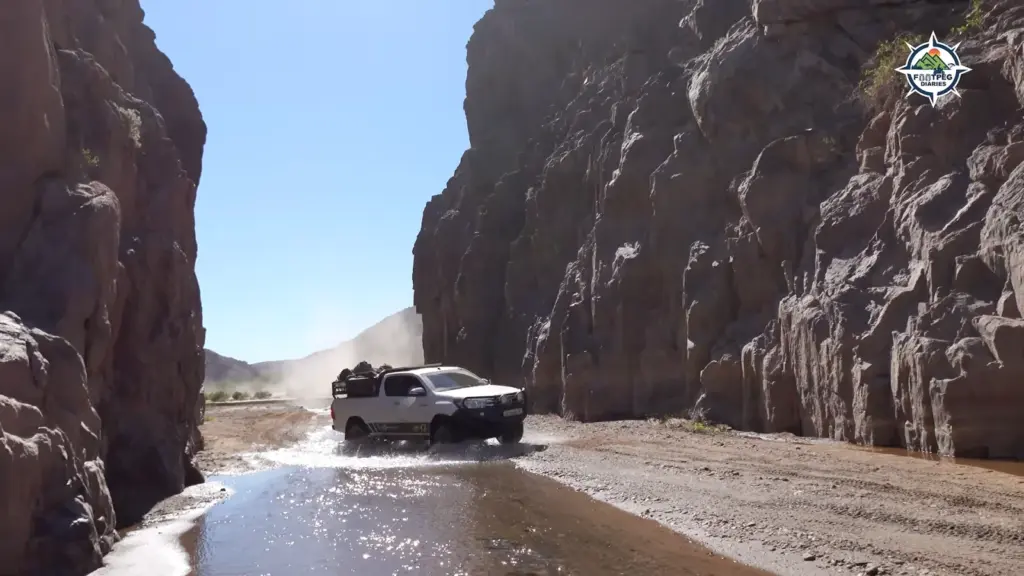
In Puros, none of the usual shops had fuel in stock, so we had to take the risk. We rode into the Hoarusib knowing that sections might still be flooded and impassable, and that once we committed downstream, turning back would burn so much fuel that reaching our overnight stop was no longer guaranteed. Straight off the bat I took a little tumble, once again hanging on to the clutch for dear life. Vehicle tracks in the sand suggested a few cars had come down in recent days, and there was an unusual amount of surface water in the river. Then there were the other tracks, elephant and lion, oddly enough heading the same way we were. As long as they kept going and we kept going, that was fine. It was all worth it when we reached the iconic Puros Canyon gates, where we took our photos and waited for the vehicles to catch up.
From the bailout track we spent the next few hours on open ground, following a plateau south, skirting wide plains and then dropping down through the valleys towards the Hoanib. The sun beat down on the flat, reflective gravel, and we went through our drinking water at an alarming rate. In the middle of nowhere we found a lovely new road and duly took it, until a man in a grader nearly blew a fuse chasing us off his immaculately graded surface. It turned out they were building a landing strip for one of the exclusive five-star lodges in the area. Sorry, bru, but how were we supposed to know? After that it was a race for the biggest shady tree in the riverbed ahead, where Adrian dropped into the dust the moment he stopped and we waited for the whole caravan to regroup.
Desert elephants in the Hoanib
For the next section we rode 40 km upstream in the Hoanib towards Sesfontein, where we hoped to find fuel. The Hoanib was our fourth major river of the trip, and for me the most beautiful so far. Broken trees and fresh elephant dung told us the big grey ones were close, though for a long time they stayed out of sight, probably hearing the bikes coming and melting into the bush. To be honest, that suited us. Meeting one of these infamously temperamental herds, or surprising a pride of lions, would be far from ideal on two wheels. The safest choice is to ignore the tracks that tempt you into the riverine bush and stay out in the open riverbed, where you have space to react and a chance to get away if something angry decides to chase you.
And then, at last, we saw a desert elephant, calmly browsing in the shade of a big tree about 100 m ahead. We wondered whether these desert giants were really as aggressive as we had been told. To find out, we sent the vehicles ahead to test his mood, then nominated Danie and his noisy T7 as our first elephant test dummy. This big guy turned out to be a gentle giant with a soft caramel centre. At the next elephant crossing we put our newly tested formula straight to work. Danie went into the danger zone first to gauge the elephant’s mood, and the rest of us gave it as much breathing room as possible as we passed. And just when you think you’ve got the hang of it, you ride past a herd with babies, and they let you know they’re keeping an eye on you.
Only a year earlier, tragedy had struck this river when a tourist was killed by a lion at a nearby camp. That stayed with us as we rode close together, stopping only where the ground was open enough to give us room to react, or when we were admiring a beautiful herd of fat springbok. Eight kilometres from Sesfontein we climbed out of the riverbed and rode through the conservancy gate. When the ranger heard where we planned to camp that night, he suggested we rethink. One of the guys argued that the chances of the lions biting everybody were almost zero, so it would only be one or two of us. We took the ranger’s advice instead and rode a little over 30 km of gravel to the campsite at Khowarib Lodge.
By then the KOVE’s morning troubles had faded from memory, and the battery seemed to have charged itself again. With more than 400 km of range in their rally-style tanks, Henry and I had none of the fuel anxiety weighing on the rest of the group, and in the late afternoon light that nimble little bike, with its big tanks and even bigger heart, put a huge grin on my face. At camp we were amazed by the luxurious shaded seating and a strange counter that provides beer in exchange for money. Henry couldn’t believe it when he spotted a green lawn and a pool of sparkling blue water, and somebody even talked a chocolate milkshake out of the bar. By our reckoning, we were seven days from civilisation.
Red sand, a sore wrist and a dying bike
By the next morning I had lost count of the days. There was good news on the fuel front: because there had been no fuel in Puros or Sesfontein, the bakkie had driven to Palmwag the night before to fetch some. With almost 90 km of heavy sand ahead, everyone took 10 litres, and the plan was to fill up properly at Palmwag and top up the jerry cans in case there was no fuel at Twyfelfontein.
It was a trip of firsts. I’m a self-confessed big-bike man who had sworn by heavy adventure bikes for years. Now, here I was on a smaller bike for the first time. So was Henry, and Dewald and Gene, riding their 500s for the first time. Rickus was riding the Kove 800 Rally for the first time, which for a man his size counts as a small bike.
The plan for the first 120 km was to follow the Khowarib trail up the Hoanib to the cattle plains, turn right into the Ombonde River, ride through Little Serengeti and join the big gravel road to the fuel station at Palmwag. Early morning found us dropping down the steep banks of the Hoanib again, and from there the riverbed became the most beautiful and demanding sand riding of the whole trip. Paul fell right where a big pride of lions had left their tracks. Scared by the unexpected discovery, he quickly got up, rode on for about 100 m, and then a local red dog came out and chased him. He was convinced that it was one of the lions, and he came around the next corner at very nearly top speed.
We were way behind schedule anyway, so we stopped to make a fire and braai the boerewors we wouldn’t be allowed to take through the red line, the veterinary fence. We were very close to where we would have camped the night before, if the ranger hadn’t warned us about the two lion prides that live there. “Let’s throw some meat on the fire in lion country,” as one of the guys said.
After brunch we turned into the canyon of the Ombonde for some lovely flowing sand riding. The red sand of the Beesvlakte is a joy, but if you don’t weight your front wheel enough through the turns, it can end in tears. I learned that the hard way. When I went down, I rolled onto my wrist and felt it hyperextend, but I didn’t want to make a thing of it. The first question from the guys, most importantly, was whether we had got it on camera. Something was definitely wrong with the wrist, but I tried to hold out for as long as I could. We still had a long way to ride, and I didn’t want to slow anyone down.
On the rocky flats of Little Serengeti I took some comfort from not being the only one who gets it wrong from time to time, but the trail kept wrenching at the handlebars and the wrist got worse with every jolt. It was clearly more than a minor knock. Out there, though, stopping is not an option. As with Paul’s hand a few days earlier, we knew the odds before we started, and I had made peace with that. There is no bike trailer and no space on a truck. Whatever happens, you ride yourself out of the desert. I was very grateful for the smooth gravel when we finally reached the fuel stop at Palmwag.
From Palmwag we pressed on along an even rockier track. Our turnoff onto the open plains of Damaraland, towards that night’s camp in the Huab riverbed, was marked by the unmistakable welwitschias, and in the golden light of late afternoon Damaraland opened up around us in a spectacular display of empty space, colour and silence. Waiting for the others in the shade of my bike, I found myself thinking about what it means to follow. We all follow someone, and we learn from someone else, but who are you really? Don’t always follow, but be open enough to change.
After more than an hour on the rocky two-spoor, the wrist flared up and gripping the bars got harder. When no one was looking, I stopped for a quick pity break to check that nothing was broken or out of place, then put my cowboy hat back on and rode off into the sunset. Eventually I stopped and softened the fully adjustable suspension on the Kove 450 Rally, which made an immediate difference, until an old gremlin reared its head again and the bike died. With daylight fading, we waited for the vehicles and tried to jump-start it, without luck. Our only option was to bump-start it and make a fast run for camp before the battery died completely, and deal with the problem in daylight the next morning. By the time we got moving the sun had set, and the pain in my wrist had to take a back seat for the final 17 km of rocky two-spoor. Up ahead, Rickus had found the campsite. To add to my woes, my headlight died too, and we rode on into the darkness until we spotted the glow of a campfire in the distance.
A jammed starter, a dry swamp and Desolation Valley
With my hand useless the next morning, I could offer little more than moral support while Adrian went through the bike. We checked the relays and electronics for a short circuit or some other cause of the battery drain and erratic ignition, and eventually traced it to a jammed starter motor that kept turning with the engine, feeding excess power back into the system and frying much of the electronics. Without a replacement starter, there was no permanent fix. Our only option was to disconnect it from the wiring harness and hope the rest of the system held together until we reached civilisation. From then on the bike had to be pull-started, which left me completely dependent on the help and goodwill of my fellow riders, on a day with 100 km of riverbed planned towards Twyfelfontein.
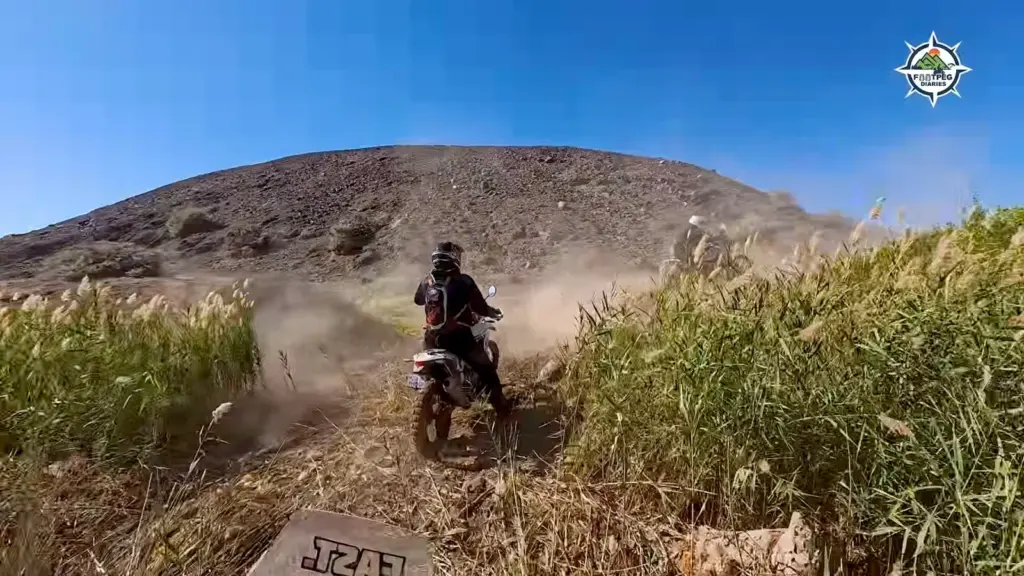
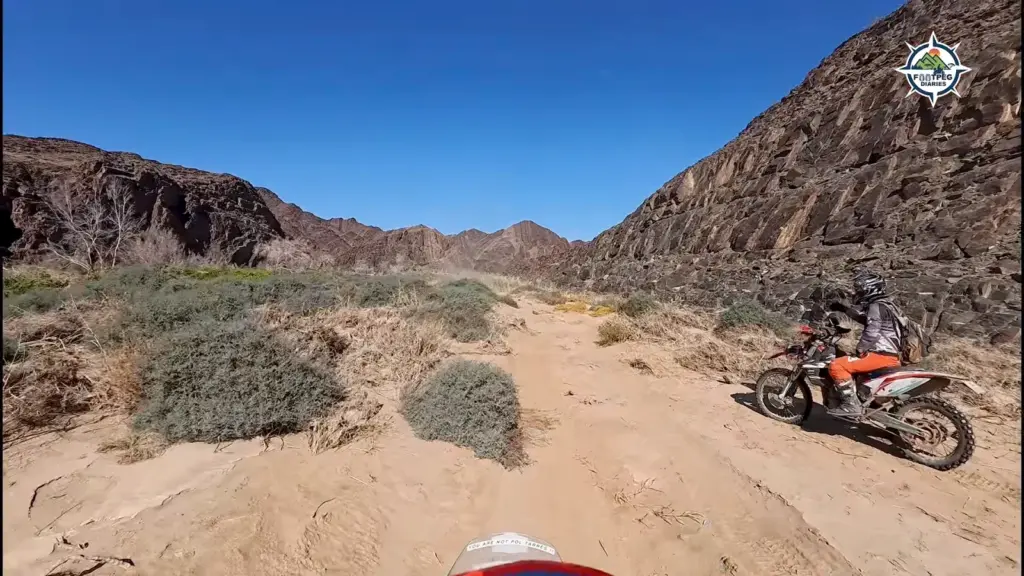
Twenty minutes in, we hit our first navigational challenge: a dry marsh at least a kilometre across. From a nearby hill it didn’t look too intimidating. In the valley below it was a maze of directionless tracks that disappeared into soft, sinking sand and reed-filled marsh. In one spot the ground gave way to deep powder sand, like a small island in the middle of the marsh, and my tension spiked, because if I stalled there, there would be no way to run-start the bike. As luck would have it: that is exactly what happened. Moments like that reminded me how dependent I was on my friends out there, especially with a wrist that wouldn’t let me grip the bars properly. Some of the guys went ahead to find an exit through the reeds and a viewpoint from which they could guide the rest of us through. After pushing my bike through hundreds of metres of fesh-fesh, we eventually found a harder dry mud track in the reeds to pull-start it. Already tired, we carried on upstream along the southern bank of the Huab, the river opening a little wider with each bend, to our lunch-time rest stop in the Abu-Huab river, where the route branches off towards Twyfelfontein. That day I didn’t say a word about Adrian’s habit of napping in the dust. My friend, the big machine, deserved his rest after all the heavy lifting he had done on my behalf that morning. Heading upstream after the break, we soon came across herds of desert elephant and pulled aside to let them pass. Riding deep sand in the midday heat is hard enough, and dropping your bike in the middle of a spooked herd is not a good idea, so we gave them a wide berth and slowed down as much as we could without tipping over. Then, at Twyfelfontein we climbed out of the river onto the plains of Damaraland again, for the Desolation Valley trail, past the Doros Crater and over Divorce Pass to our last camp in the Ugab riverbed. The wrist was getting worse by the hour, and as the road got rockier the KOVE started acting up again, surging between high revs and sudden flat spots. To keep the group moving, I rode at the front with Adrian and Henry close behind in case I needed a bump start, and I needed it more than once. There was no option but to keep the revs high, hang on and attack the rocky mountainside head on. At last we dropped into the Ugab valley and reached camp as the sun set, and everyone lent a hand to get the fire going. It was our last night of wild camping in the desert, and the guys were a little more subdued than usual, as if already mourning the return to civilisation and the responsibilities waiting there.
Calling it
On the last morning I said a quiet prayer that the bike would make it to Hentiesbaai. Realistically, it shouldn’t have lasted that long. Then again, neither should I. The plan was to ride the Ugab riverbed all the way to the coast and then take the beach down to Hentiesbaai. The first 20 minutes in the Ugab told me what I needed to know. The bike sputtered, choked and lurched, and I couldn’t hold a steady pace. The wrist was worse than the day before, though I wouldn’t admit it to anyone. That morning the ligaments on my hand were a deep purple.
As we passed the Ugab Rhino Camp we stopped for a breather, and I made the call I didn’t want to make. I would let the group ride the river while I bailed out on the gravel track to the big salt road towards Hentiesbaai. Riding it alone would be reckless, because if the bike died again I would be stranded in the desert, but I didn’t want to keep anyone from what promised to be a very special last riverbed. To my surprise, Adrian, Henry and Paul followed me, determined to make sure I reached town safely. I felt guilty and deeply grateful in equal measure, riding into that vast open desert knowing my brothers were behind me, giving up their last day in the riverbeds to keep me safe.
Back in the Ugab, the others set off at a good pace but soon struggled to find a passable track. Danie was once again sent ahead as test dummy, this time to scout a rocky ledge that the vehicles could also get over. It was no use. The way ahead was a no-go area, and the guys had no choice but to ride out on the same road we had taken an hour earlier.
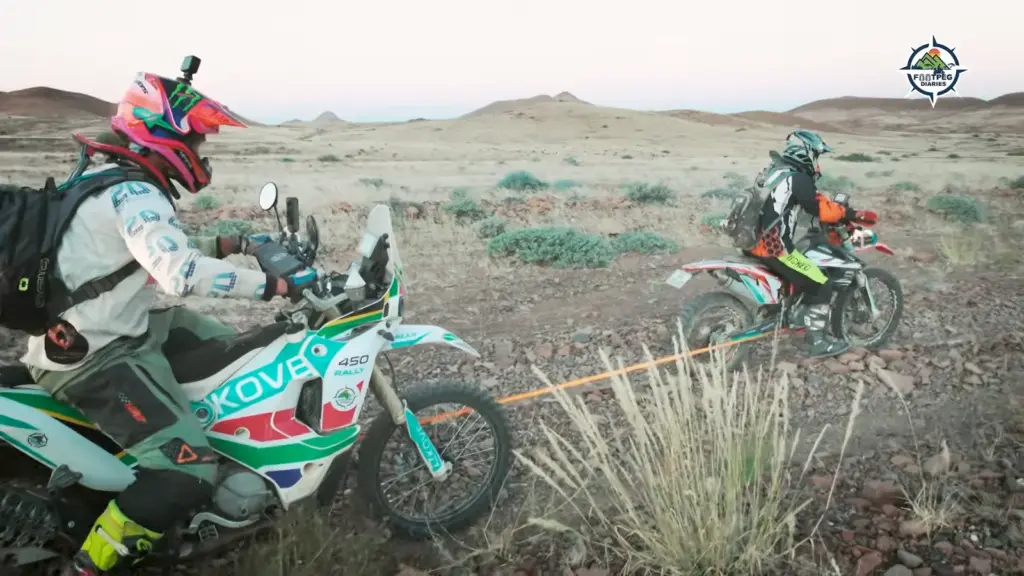
On the salt road we were making good time, or so we thought, until my bike finally gave up the ghost just 80 km short of Hentiesbaai. We tied two straps together and hooked it to Adrian’s 500. It wasn’t the ending I wanted, but it was time to accept defeat, take the knock and head for a cold beer and our first kitchen-cooked lunch in what felt like weeks.
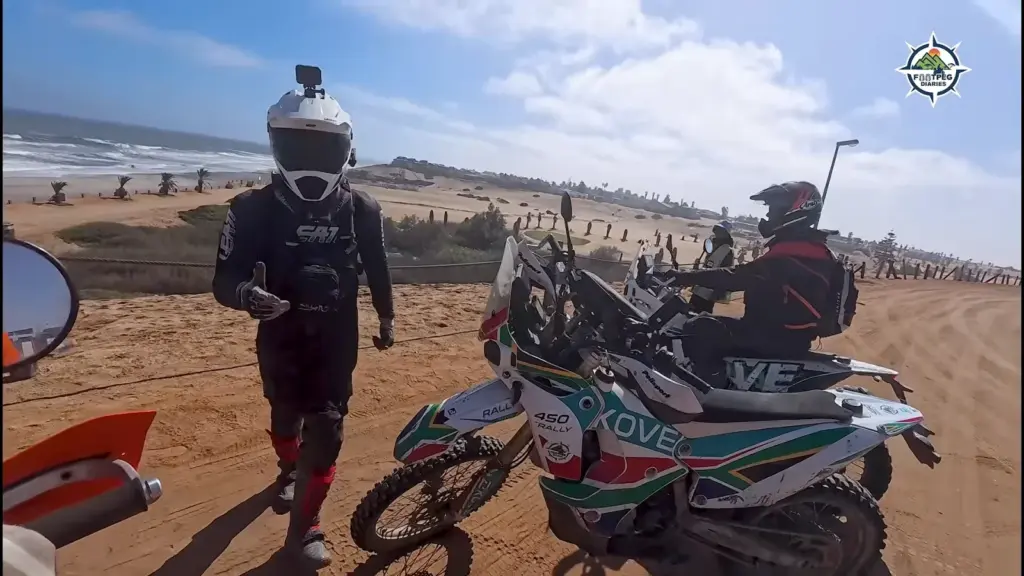
Since they couldn’t reach the Skeleton Coast Park through the Ugab that morning, the others took a detour onto the beach on their way in, riding the last few kilometres to Hentiesbaai through the afternoon mist rolling in off the Atlantic. The high pace and the loose beach sand caught a few of them off guard. One rider arrived with his helmet full of sand, and it turned out a game of ostrich had been played on the way. Eugene, by all accounts, won. With everyone back together, we celebrated the end of our last full day of riding.
The last 150 km
For all intents and purposes, my adventure was over. I spent the short liaison from Hentiesbaai back to Usakos on the back of a kind Samaritan’s bakkie, staring into the sunrise over the desert and wondering where my friends were riding. They were riding straight into the sun through the morning’s coastal fog. The final 150 km back to our vehicles gave them just enough time to reflect on the journey, and on how fortunate we were to spend nearly two weeks exploring some of Southern Africa’s most picturesque and most dangerous landscapes. We all met up again in Usakos to load the bikes and the gear, and one of the guys reckoned we had done at least 500 km in the riverbeds alone.
Asked what stood out, the answers came easily. Conquering Van Zyl’s. The elephants in the riverbeds. The food, which earned the cook plenty of compliments because the guys were very hungry every night. The scenery, the wildlife and the nature. The 20-odd kilometres of sand surfing on the Skeleton Coast. The number of times Paul had to pick up his bike. And above all, the people. As one of the guys put it, you can always come back to a place, but it’s the people who make the trip, and he went home having got to know twelve great guys.
What the bikes taught us
One of the guys had come to the trip from a 990, and for the first two days on gravel he was disappointed with his 500, which jumped around and wasn’t as soft and plush as the big bike. After nine days he called it the perfect bike for the trip: light and nimble, easy to ride, and not leaving him tired at the end of the day. His formula was a lighter bike, enough fuel and proper suspension. He has been touring Namibia on adventure bikes and in 4x4s for about 22 years, and he rated this among the best five days of adventure riding of his life. He said he was so glad to be on the smaller bike, because he didn’t think he would have enjoyed it as much on a bigger one.
Rickus has owned a 950 Super Enduro, a 1290 and a 950 Adventure, so he knows big adventure bikes. He found the Kove 800 Rally’s standard suspension unbelievably good, if a little on the soft side for a heavier rider (upwards of 120 kg). He had fitted heavier springs just before the trip and never had time to play with the preload, especially at the front, and that messed him around a bit. But the moment you ride it more aggressively, in the attack position, he said, it’s unbelievable what that bike does. People throw the term “big dirt bike” around too easily, but this is one. In his words: “This thing is crazy. It’s the business. It’s all that they say it is and more.”
As for my own Kove 450 Rally, those rally tanks took the fuel worries out of the most remote days, and on fast gravel it made me smile so much that I cooked two mousses proving it. The jammed starter motor was the one fault we couldn’t fix in the field.
What Rocks & Riverbeds taught us
Go lighter than you think. The lighter bikes were the success of the trip. The rider who came on a 500 instead of his 990 called it the perfect bike for the trip: light, nimble and easy to ride, and he wasn’t tired at the end of the day. On the flooded Kunene track, the riders on the big bikes were the first to struggle when the rocks gave way to deep, soft sand.
Plan your fuel before you plan your route. Opuwo was our last proper filling station for days. After that we bought fuel in containers from roadside sellers at Okangwati, found none at all in Puros or Sesfontein, and only kept going because the bakkie made a night run to Palmwag. Carry what you need, know exactly where you are committing to a one-way route, and if you can, ride a bike with a long-range tank. With the Kove 450 Rally’s more than 400 km of range in desert riding conditions, Henry and I never had to worry.
Mousses don’t do 130 on gravel. I thought it was only gravel, so it would be fine. It wasn’t, and I cooked two mousses on the fast roads of the first few days. If your trip starts with long stretches of fast gravel, slow down to less than 100 km/h or run tubes. It’s always a good idea to carry spare tubes either way.
Respect the wildlife, and take local advice. Stay in the open riverbed where you have room to react, not in the riverine bush along its edges. Give elephants a very wide berth, especially herds with calves, ride close together in lion country and listen to the rangers about where to camp. They know where the prides are.
Carry a proper kit and know how to use it. Adrian’s “basic standard kit” that he used for the field service on his KTM 500 makes for a good checklist: the bike’s own tool kit, spares for the standard bolts on the bike, two litres of engine oil (his engine takes 1.2, the rest is for topping up on the ride), an oil filter, an old ice-cream tub to drain the oil into (never drain oil into the environment!), chain lube, an air filter cloth, a pre-oiled spare foam filter and filter oil, grease, rear brake pads (mud and wet sand can wear them down very quickly), extra coolant, brake fluid, a spare tube, proper long tyre levers, a chain breaker, duct tape, super glue, Pratley Steel, zip-lock bags, washing powder and hand cleaner. On this trip we dealt with a clutch master cylinder, a broken battery cable, filthy air filters, fuel pumps, oil leaks, a fuel pickup that couldn’t reach the bottom of the tank, a flat battery, blown relays, two mousses and a starter motor.
Route your support vehicles separately, and agree exactly where you’ll meet. Some of the best tracks, like Van Zyl’s, are no place for a top-heavy, loaded Land Cruiser. Send it around, and make very sure everyone knows which campsite you mean, or you may end up sleeping in your riding gear.
The rain changes everything. A good rainy season means flooded riverbed tracks, washed-out sand, eroded passes and extra surface water in the rivers. Expect to turn back, and have a plan B for every day. Prepping a plan C won’t hurt, either. No one is coming to save you. We had no space on a truck for a bike or a rider. Whatever happens, you have to find your own way through and ride yourself out of the desert, so make your decisions with that in mind, and know when to call it.
Why we go
Riding these technical tracks is risky. It can even be deadly. You face the dangers head on and make hundreds of small but crucial decisions every day, decisions that keep you alive, and that makes you appreciate just how fragile life is. Out here you can feel your mortality against your skin. Giving up or complaining will get you nowhere. We all believe we know our limits, but out there those boundaries shift. Being injured forces you to dig deeper than you ever would in everyday life, and you learn to push your body further than you remembered it could go.
Mechanical problems, blown fuses and dead batteries all become manageable hurdles, overcome with pragmatism, patience and help from the people around you. Modern life tells us that we are all islands, strong and capable enough to manage alone. Out here you relearn that we are all stronger together. The joy of unguarded laughter and the comfort of familiar faces carry you through each day.
The views, the new experiences, the magical moments and those spectacular skies will stay with me for a very long time. Long enough, if I’m lucky, to draw me back one day to the heart of the Namib, where you can feel the emptiness and yet be completely fulfilled. Until then, go chase the horizon.
Watch the series
Rocks & Riverbeds is a five-part series on the Footpeg Diaries YouTube channel. It was made possible by KOVE Motorcycles South Africa, with the riders protected by Leatt and the riding captured on Insta360 cameras. You’ll find all our adventures at youtube.com/@FootpegDiaries and footpegdiaries.com.