
Share your love
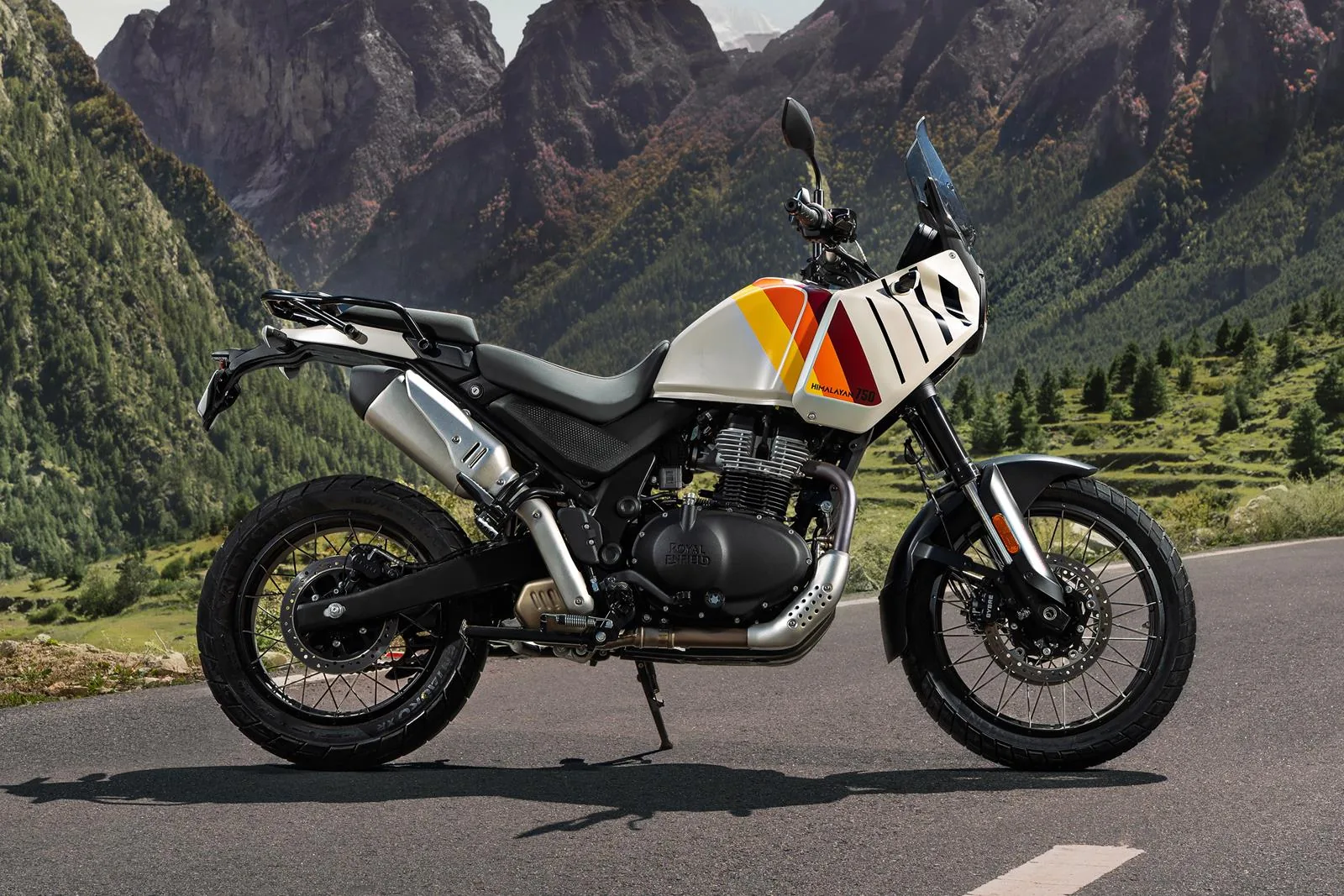
The Himalayan Gets a Twin: Royal Enfield’s 750 and What 450 Owners Should Know
Royal Enfield's Himalayan 750, revealed at EICMA 2026: the 743cc twin, the full specs, UK prices, how it compares with the 450 and what it means here.
Updated 3 November 2026: Royal Enfield has revealed the Himalayan 750 at EICMA in Milan, so this article, first published before the reveal, now carries the confirmed details.
If you own a Himalayan 450, you already know your wish list. More shove for the N1, for the moment a truck slows ahead of you at 110 km/h and you have to decide whether the gap is really long enough. A smoother engine for the third hour at the national limit. A bit more reserve for two-up days. On 3 November in Milan, Royal Enfield answered the power part of that list with the Himalayan 750, the first twin-cylinder Himalayan and the new flagship above the 450 and the original 411. Whether it is smoother has to wait for the first road tests.
The answer comes with catches. This is more bike on tar and a little less bike on rubble, and which you care about decides whether the 750 is your next motorcycle or something Royal Enfield built for someone else. It also shows how far the name has travelled: the original 411 of early 2016 made about 24.5 hp (18.3 kW), and the 450 of late 2023 about 40 hp (29.4 kW). The 750 passes 54 hp, so power has more than doubled in a decade.
Sixty-three Newton metres and the N1 overtake
The new engine is a 743cc air- and oil-cooled parallel twin, the first 750 in Royal Enfield’s history and a step above its familiar 650 twins. TopSpeed notes the bore is 5.5 mm wider than the 650’s with the same stroke, which suggests an evolution of the 650 design. Royal Enfield quotes 54 hp (40.4 kW) at 7,000 rpm and 63 Nm at 5,000 rpm. A six-speed gearbox with a slip-and-assist clutch drives the chain.
Set that next to the 450 and the gap is real. The single makes about 40 hp and 40 Nm, so the twin has more than a third more power and more than half as much torque again, and its claimed power-to-weight is roughly a fifth better despite the extra mass. Royal Enfield says the 750 makes 90% of its torque from 3,500 rpm, so the twin pulls from low down and keeps going where the single runs out.
Picture a 450 at 100 km/h behind a slow truck on an N1 climb: a downshift or two and a patient wait. On paper the 750 should ask for less of both. On the Highveld, where Johannesburg sits about 1,750 m above sea level and every petrol engine pays an altitude tax, a bigger engine starts with more to lose. That is a reading of the numbers, not a road test.
Air and oil cooling in a Karoo January
Here is the first honest catch. Your 450 is liquid-cooled; the 750 is cooled by air and oil. That keeps things simple and suits Royal Enfield’s old-school character. It also leaves one thing to watch in a South African summer: a loaded bike crawling through Gauteng stop-start in 35-degree heat, or grinding up a Karoo pass in January, may have less cooling margin than a radiator would give it.
That is a question for the first long-term tests, not a finding. Plenty of air- and oil-cooled engines cope with African heat, but we would want to see this one do it before recommending it for Lesotho in February.
A 19-inch front wheel and what it costs you off the tar
The steel frame uses the engine as a stressed member. Up front is a 43 mm Showa upside-down fork with 190 mm of travel, adjustable for preload, compression and rebound. At the back a linked Showa shock with remote preload adjustment gives 175 mm. The wheels are a 19-inch front and a 17-inch rear, cast or spoked depending on the version, wearing tubeless 110/80-19 and 150/70-17 tyres. Twin 280 mm front discs and a 255 mm rear disc do the stopping, where the 450 uses a single 320 mm front disc and a 270 mm rear.
Your 450 has a 21-inch front, 200 mm of travel at each end and 230 mm of ground clearance, against the 750’s 205 mm. In our opinion this is the real dividing line between the two. A 21-inch wheel rolls over potholes, washboard and loose Karoo gravel with a calm a 19-inch wheel cannot quite match, and the extra travel forgives tired mistakes. The 19-inch front trades that for tar manners and more road-biased tyre choices. The 750 will manage a dirt road to a farm lodge, but we would not point it at a rocky Lesotho pass.
The extra 28 kg, and what it buys
Royal Enfield quotes a kerb weight of 224 kg with 90% fuel and oil, against 196 kg for the 450, so you carry 28 kg more. The payload barely moves, at 194 kg for the 750 and 198 kg for the 450: the extra weight is the bike, not extra carrying capacity. The seat sits at 815 mm, with lower and touring seats as accessories, against 825 mm on the standard 450 seat.
The 17.8-litre tank is slightly bigger than the 450’s 17 litres, and Royal Enfield has not yet published a fuel consumption figure. At a typical 4.5 to 5 litres per 100 km for a twin this size, that would mean roughly 350 to 400 km between fills, about Johannesburg to Bloemfontein on the N1. Estimates flatter, and a headwind at 120 km/h will eat into that, so plan Karoo fuel stops.
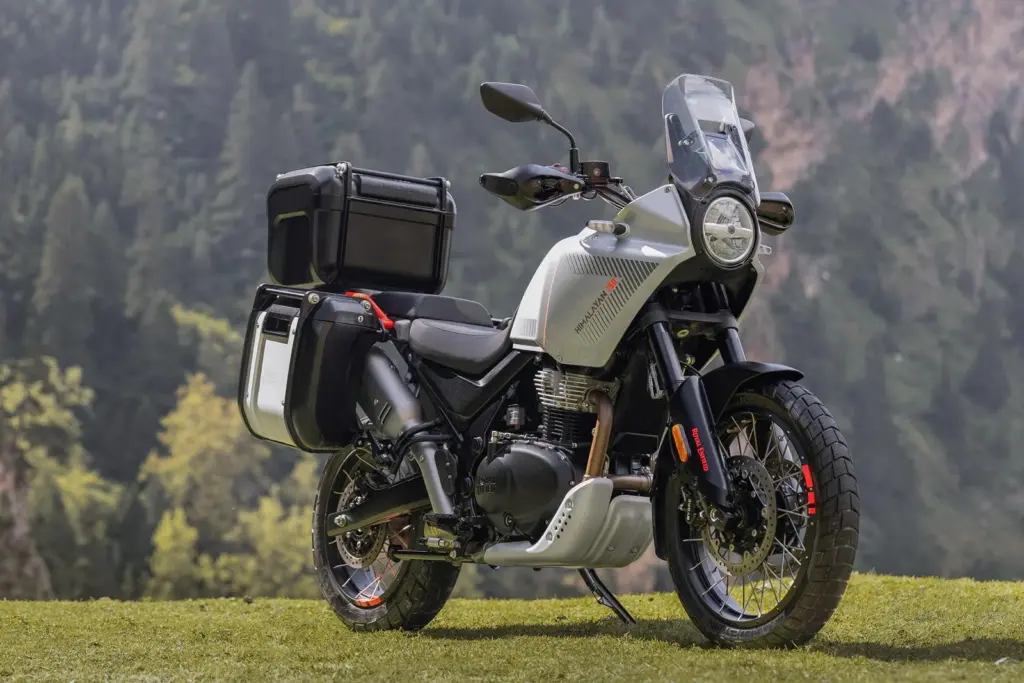
The touring kit
TopSpeed notes the 750 is the first Himalayan with a six-axis IMU. That sensor feeds cornering ABS, with the rear ABS switchable off, and lean-sensitive traction control with Low, Medium, High and Off settings. There are five riding modes, Road, Road Sport, Rain, Trail and Custom, plus ride-by-wire, cruise control and tyre pressure monitoring.
Cruise control is the item we would value most here. A 400 km stretch of the N1 at a steady 110 km/h is exactly where a right wrist starts to complain. The round 4-inch TFT connects to your phone for navigation, calls and messages, and a 7-inch LED headlight, an adjustable windscreen, two USB-C sockets and separate rider and pillion seats complete the touring package.
Colours and UK prices, from £6,999 to £8,699
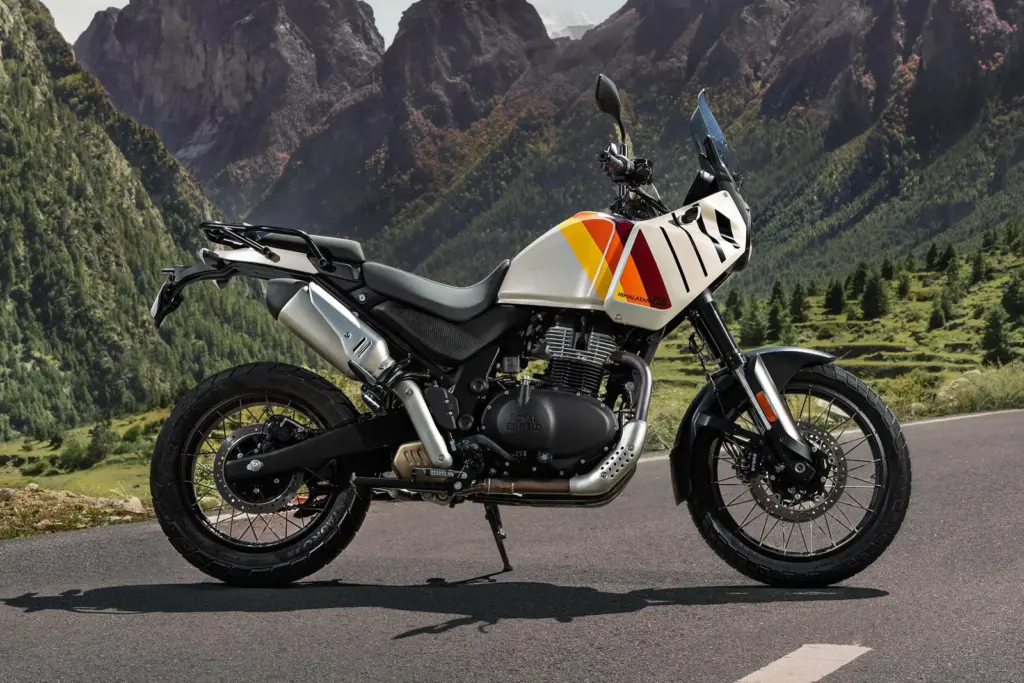
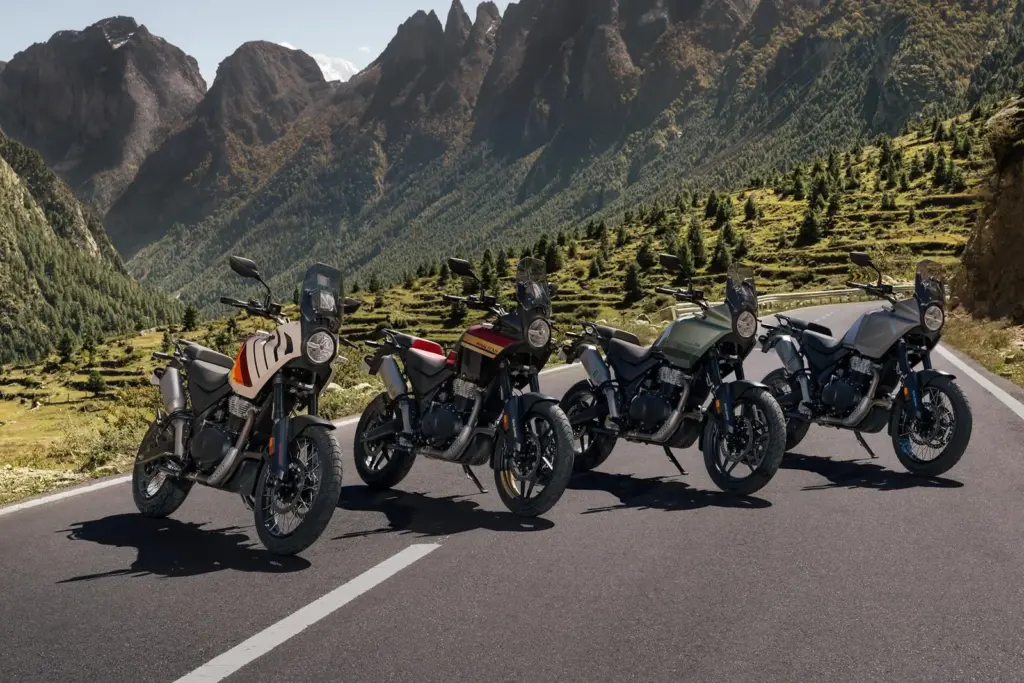
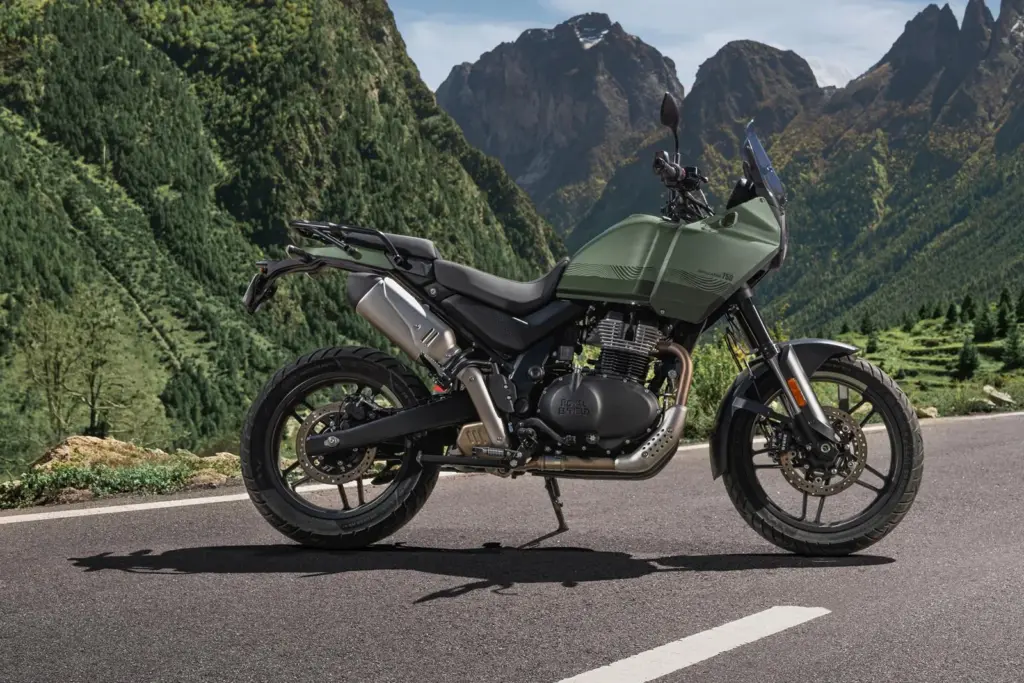
There are five colours. In the UK the range starts at £6,999 for the cast-wheel bike in Aztec Green, with Tectonic Black also on cast wheels. The spoked-wheel versions in Viking Bronze or Siberia White cost £7,299, and the flagship in Antarctic Silver, on spoked wheels with GIVI side cases and top box, heated grips, hand guards and a skid plate, costs £8,699. Bookings opened in Europe on the day of the reveal, and Royal Enfield is expected to launch the bike in India at its Motoverse festival in Goa, from 27 to 29 November, though it has not confirmed that.
For 450 owners weighing a swap, TopSpeed lists warranty and service intervals as still to be confirmed, and both matter when you are comparing running costs against a bike you know.
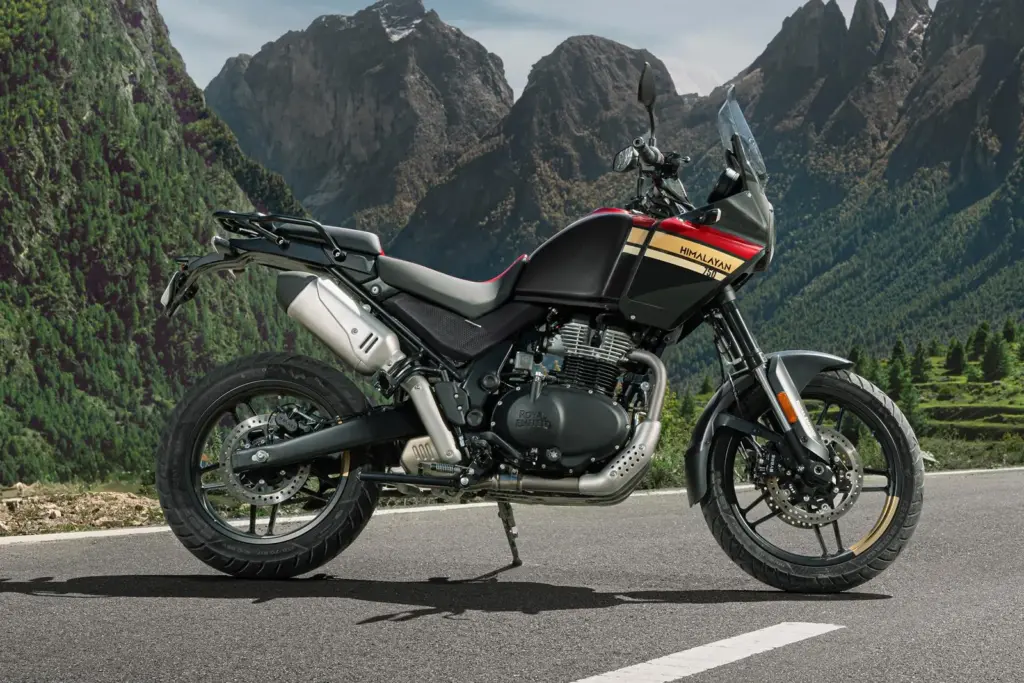
Tectonic Black, on cast wheels. Showa suspension gives 190 mm of travel at the front and 175 mm at the back. Image: Royal Enfield 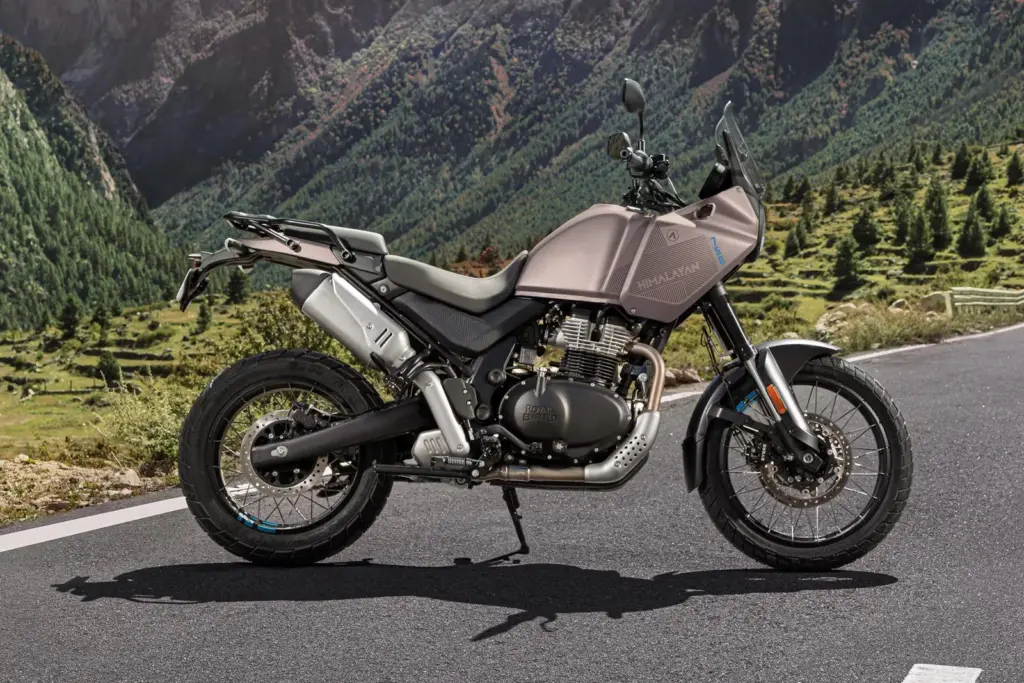
Viking Bronze. The new 743cc twin is air- and oil-cooled. Image: Royal Enfield 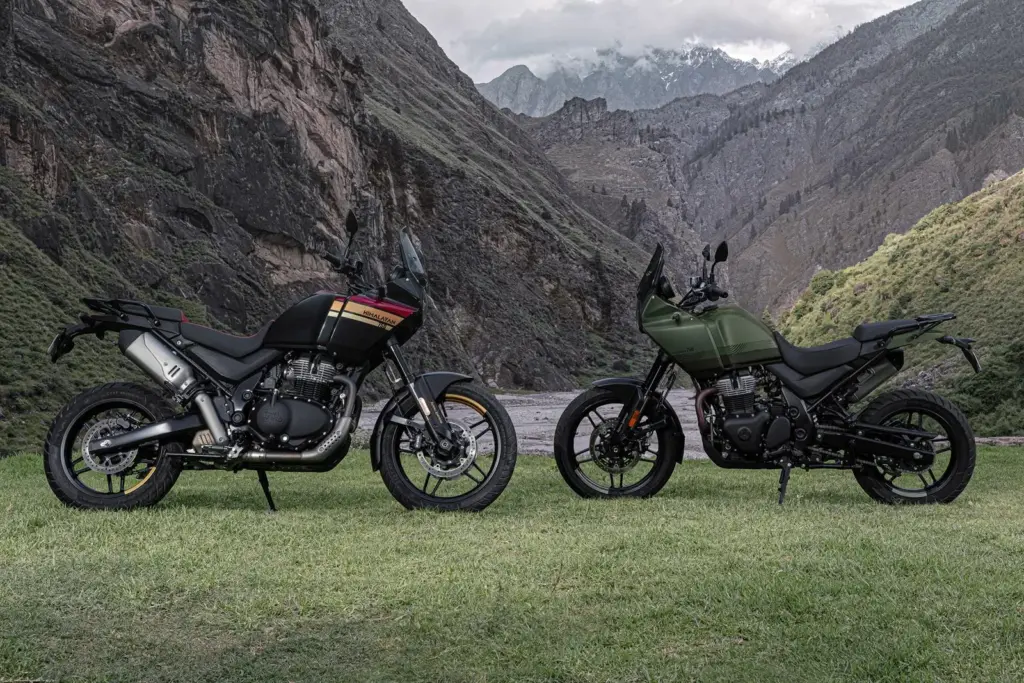
A claimed 224 kg with 90% fuel and an 815 mm seat. Image: Royal Enfield 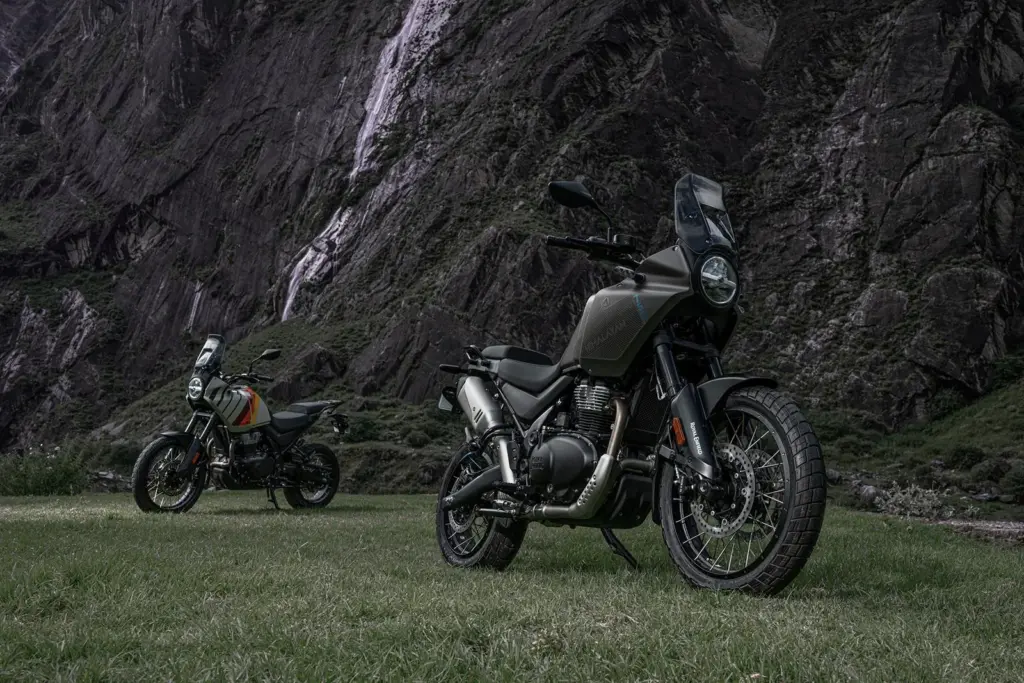
Cruise control and five riding modes are standard. Image: Royal Enfield
The 450 and the 750, line by line
| Himalayan 450 | Himalayan 750 | |
|---|---|---|
| Engine | 452cc liquid-cooled single | 743cc air- and oil-cooled parallel twin |
| Power | about 40 hp (29.4 kW) | 54 hp (40.4 kW) |
| Torque | 40 Nm | 63 Nm |
| Wheels | 21-inch front, 17-inch rear | 19-inch front, 17-inch rear |
| Suspension travel | 200 mm front and rear | 190 mm front, 175 mm rear |
| Ground clearance | 230 mm | 205 mm |
| Front brakes | single 320 mm disc | twin 280 mm discs |
| Seat height | 825 mm standard | 815 mm |
| Weight | 196 kg (90% fuel and oil) | 224 kg (90% fuel and oil) |
| South African price | R105,500 at Moto Royale | Not announced |
Wait for the 750, or ride the 450 you can buy today?
Royal Enfield is sold here through its dealers, including Moto Royale, which lists the Himalayan 450 on its Daily Rider page at R105,500. Royal Enfield has not announced when the 750 reaches South Africa or what it will cost. Its South African website already lists the bike with full specifications and a sign-up for updates, but still gives no price or date. Read how Royal Enfield came back to South Africa for the background.
The UK prices hint at where it may land. At £6,999 it is one of the cheapest twin-cylinder adventure tourers on sale in Britain, and if Royal Enfield keeps a similar position here, it would sit well below most of the twins in South African showrooms. Royal Enfield was not the only brand with news in Milan, and our EICMA 2026 round-up shows what else will be chasing the same money.
Our plain advice is opinion. If you ride a lot of gravel, Karoo back roads or mountain passes, keep the 450: the bigger front wheel, longer travel and extra clearance are what that riding rewards. If your Himalayan lives on the N-roads, you often carry a pillion and the engine is what you wish were bigger, the 750 deserves a test ride the moment a dealer has one. If you need a bike this summer, buy what is on the floor, because an unannounced date is a poor reason to wait. Royal Enfield’s CEO calls the 750, in Visordown’s report, “a motorcycle that builds on a decade of the Himalayan’s legacy.” The 450 is a big part of that decade, and a bigger sibling does not make it obsolete.
Questions 450 owners are asking
Is the Himalayan 750 confirmed, and does it replace the 450?
It is confirmed. Royal Enfield revealed it at EICMA in Milan on 3 November 2026, as a 2027 model. It sits above the 450 and the original 411 in Royal Enfield’s Himalayan line-up, and Royal Enfield has not said the 450 is being dropped.
How much more power does it make than a 450?
54 hp (40.4 kW) and 63 Nm, against about 40 hp (29.4 kW) and 40 Nm: more than a third more power and more than half as much torque again.
Is the 750 better off the tar than the 450?
No. With a 19-inch front wheel, less travel and 205 mm of ground clearance against the 450’s 230 mm, it is the more road-biased of the two.
How much does the Himalayan 750 cost?
From £6,999 to £8,699 in the UK, depending on version. South African pricing has not been announced.
When will the Himalayan 750 come to South Africa?
Not announced yet. Bookings opened in Europe on 3 November, and India is expected to get it at Motoverse later in November.

Jean Claude Murphy
Articles: 12Related Posts
One comment
Join the conversation
Daily Rider members can comment on every story. Log in, or join free in a minute.
Really looking forward to seeing where Royal Enfield goes with this one.
One thing worth keeping in mind is that most of the specs floating around (especially power figures) are still estimates at this stage. From what’s been shown so far, it seems more like a heavily reworked version of the 650 twin rather than a completely new engine platform.
Also, the 19/17 wheel setup suggests this might lean more toward a touring-focused adventure bike rather than a hardcore off-roader like the Himalayan 450.
The biggest question for me is weight, if it carries over the 650 platform DNA, it could end up being quite a heavy machine, which might impact its off-road ability.
That said, features like expected cruise control would be a huge win for long-distance riders. Definitely one to watch.